Clay Masterson, Backcountry Conditioning Expert & Gear Pragmatist
June 29, 2026 · 10 min read
Why You Should Avoid Waterproof Trail Shoes for Ultra Races
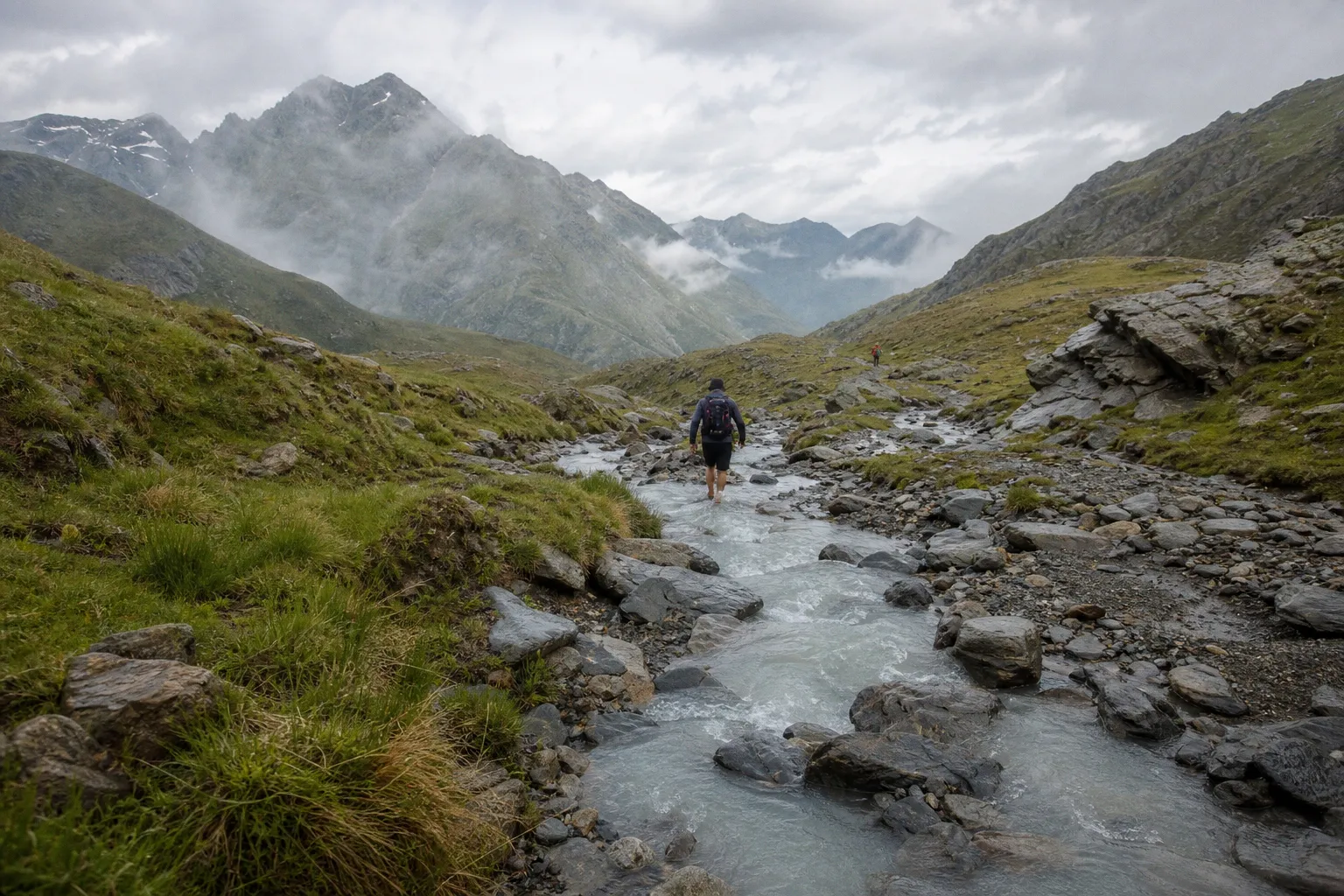
Seventy miles into a mountain ultra, your feet aren't wet because of the rain. They're wet because your shoes refused to let the water out.
Why You Should Avoid Waterproof Trail Shoes for Ultra Races
I've pulled more runners out of aid stations with destroyed feet than I care to count. Blistered, macerated, swollen, leaking plasma. The common thread? Waterproof shoes. The marketing promised protection. The reality was a footbath that lasted the entire back half of the race.
Let me break down exactly why this happens, what the cost is, and what you should be running in instead.
The Physics of the Bathtub Effect
Waterproof trail shoes use a membrane — most commonly Gore-Tex — laminated inside the upper. The membrane's job is to block external water from entering the shoe while theoretically allowing sweat vapor to escape. In a controlled lab, that sounds clean. On a trail, in a 50-mile race, it's a liability.
Here's the problem: water doesn't enter your shoe through the upper. It enters through the ankle collar. Stream crossings, mud bogs, sustained rain, even sweat accumulation — all of it dumps directly into the shoe from above. Once that water is inside, the membrane won't let it drain back out. The shoe becomes a sealed container. Your foot sits in it. Sealed environments behave the same way regardless of the application — the same vapor-barrier physics that fail in trail shoes drive design headaches in everything from sealed automotive enclosures to marine electronics. Moisture trapped in a closed system stays in that closed system.
Your foot doesn't care about marketing copy. It cares about drainage.
This is the bathtub effect, and it isn't theoretical. If you've spent any time in ultra-running communities, you've seen the photos — runners wringing out their shoes at aid stations, socks sloughing off white pruney skin. The membrane did its job. It kept outside water out. Unfortunately, it kept inside water in.
The physics aren't complicated. Vapor barriers work both ways. Once the membrane is saturated at any seam or compromised by debris, sweat, or flex, it stops breathing efficiently. The hydrophobic layer that repels external moisture also repels your sweat from evaporating. You end up with a humid, sealed microclimate where heat and moisture compound with every step.
What Maceration Actually Does to Your Feet
Maceration isn't a word most runners use until they've experienced it. Then they never forget it. Skin maceration is what happens when tissue stays wet for too long — the outer layer softens, breaks down, and loses its structural integrity. It turns white. It wrinkles. It sloughs off.
In an ultra, this is catastrophic. Your foot takes thousands of impacts per mile. With every footfall, the softened skin rubs against a damp sock inside a saturated shoe. Friction goes through the roof. Blisters form faster. Existing blisters rupture. The skin beneath becomes exposed and raw.
I've seen runners DNF at mile 40 because the skin on their soles peeled off like wet paper. They didn't get there from rain alone. They got there because their shoes held the water against their feet for the entire second half of the race. The membrane trapped the moisture that should've drained at every creek crossing and puddle splash.
The risk compounds over distance. A two-hour trail run with wet feet is uncomfortable. A ten-hour ultra with wet feet is a medical event. Tissues macerated beyond a certain threshold don't recover during the race. They require rest, drying time, and sometimes medical intervention. If you're pushing for a finish, you're gambling your feet on a technology that was designed for short mountain hikes, not 30-hour sufferfests.
And maceration doesn't just threaten blisters. It compromises your skin's natural barrier function. Bacteria get in. Fungal infections set up camp. Hot spots turn into open wounds. The trail runner who finishes an ultra in soaked GTX shoes often spends the next two weeks off their feet entirely, nursing wounds that could've been avoided with the right upper material.
Breathability Is the Lie Nobody Calls Out
Let's talk breathability. Gore-Tex and similar membranes are marketed as breathable. The technical literature uses words like "moisture vapor transmission." On paper, water vapor passes through the membrane at some rate. In practice, that rate is a fraction of what an open-weave engineered mesh upper provides.
A non-waterproof trail shoe uses mesh that's literally porous. Air flows through it. Water flows through it — both directions. Your foot can dump heat. Sweat can evaporate. Water that enters from a stream crossing drains out within minutes. The shoe returns to a manageable moisture level as you run.
A waterproof shoe can't do that. The membrane slows vapor transfer significantly. Lab comparisons show near-zero improvement in breathability over standard mesh under real exertion conditions. Add in the fact that the membrane swells slightly when wet and you've got a shoe that performs worse the more you need it to perform.
A waterproof trail shoe at mile 60 is a wet sock wrapped around a foot that can't cool itself.
This matters for thermoregulation. Your foot is one of the densest concentrations of sweat glands on your body. In a hot ultra, your feet are doing serious cooling work. Trapping that heat inside a membrane-laced shoe pushes your core temperature up faster. It changes your pace. It changes your fueling. It changes whether you finish.
There's also the issue of heat dissipation through the upper itself. Open mesh allows convective cooling as air passes over your foot with each stride. A sealed upper kills that mechanism. Your foot temperature climbs. Your comfort plummets. Your body diverts blood flow to manage core temperature. Your legs get less oxygen. Your pace suffers.
The Weight Problem Nobody Wants to Talk About
Waterproof shoes weigh more. Not by a lot in your hand — typically 30 to 50 grams per shoe compared to the non-waterproof version. That's a pair of energy gels per foot. It feels negligible standing in the shop.
It's not negligible at mile 60.
Running economy is real. Every gram you carry above your feet costs you oxygen over distance. The standard figure is roughly 1% energy cost per 100 grams per shoe over a marathon. In an ultra, where you're already depleting glycogen and pushing lactate thresholds, that 30 to 50 grams compounds with every step. Over 50 miles, you're burning extra calories for no performance gain. You're hauling dead weight for the privilege of having wet feet.
There's also a wet-weight penalty. Once a waterproof shoe absorbs water — and it will, somewhere, somehow — that water adds mass. Non-waterproof mesh drains continuously. The weight stabilizes. A waterproof shoe holds onto water like a sponge. The weight grows. Your legs notice. Your knees notice. Your feet notice. By the time you're deep into the back half of a race, you've added an effective 100+ grams of water to each foot that won't shake loose until you stop moving.
Comparison Table: Waterproof vs Non-Waterproof for Ultra Distance
| Parameter | Waterproof (GTX) | Non-Waterproof Mesh |
|---|---|---|
| Drainage after stream crossing | Trapped, hours to dry | Drains in minutes |
| Breathability under exertion | Severely limited | High vapor transfer |
| Average weight per shoe | 30–50g heavier | Lighter baseline |
| Wet-weight gain | Holds water in upper | Sheds water continuously |
| Blister risk over 50+ miles | High due to maceration | Lower with active drainage |
| Thermoregulation | Heat builds up | Foot cools naturally |
| Drying time post-race | 24+ hours | A few hours |
| Best use case | Cold, short, dry snow | Warm to moderate, long efforts |
This isn't a close contest for ultra distance. The numbers don't lie. The real-world outcomes don't lie.
When Waterproof Is Actually the Right Call
I'm not going to tell you to burn your waterproof shoes. They have a place. Just not in ultras.
If you're doing a winter day hike where stream crossings are unlikely and the trail is mostly dry snow, a waterproof shoe makes sense. The membrane keeps snowmelt from soaking through and gives you a thermal buffer in cold conditions. Same logic for a short summit push in shoulder season when the forecast is stable and you want wind protection on the upper.
Waterproof shoes also serve hikers who aren't logging 30+ miles and who struggle with cold feet. The warmth retention is real. For that user, in that context, GTX is the right tool.
But ultra running isn't that context. Ultra running is sustained output over hours, across varied terrain, through unpredictable weather, with your foot as a primary contact surface doing massive mechanical work. The engineering requirements are different. The optimal shoe is different. And a waterproof membrane is, in most cases, the wrong answer.
If you're running a winter ultra where snow and ice dominate the surface and water entry is unlikely, GTX can work — but you're still trading breathability for protection. Make that choice consciously, not because a brand convinced you their shoe is "all-conditions." Nothing is all-conditions. Everything is a tradeoff.
What to Run In Instead
For ultras, you want a shoe with a well-ventilated engineered mesh upper, aggressive lugs matched to your terrain, and a rock plate if you're running technical granite. Look for shoes specifically marketed as "ultra-distance" or "long-haul" — brands like Hoka, Speedland, Nnormal, Topo, and select Salomon and Altra models have built their ultra lines around drainage and breathability rather than waterproofing.
Test your shoes in training the way you'll race in them. Run a long run through a creek. Run a long run in rain. See how the shoe handles water. If your feet stay soaked for hours afterward, the shoe is wrong for ultras. Drainage isn't a feature you read about — it's something you verify with your own feet, on your own terrain, in your own conditions.
Sock choice matters too. A hydrophobic merino blend or a synthetic weave designed to manage moisture will outperform cotton in any shoe. But no sock saves you from a sealed waterproof upper. The shoe has to drain first. The sock has to manage what remains.
The Verdict
Waterproof trail shoes and ultra-distance running are incompatible. The membrane that promises protection delivers a sealed, waterlogged environment that destroys your feet, traps heat, costs you energy, and slows you down over the long miles. The bathtub effect is real. Skin maceration is real. Race-ending blisters are real.
If you're prepping for an ultra, leave the Gore-Tex at home. Trust drainage. Trust mesh. Trust your feet to handle the moisture they're going to encounter — because they will handle it better than a sealed membrane ever will.
The trail doesn't care what your shoes are made of. It only cares whether you can finish. Choose accordingly.