Clay Masterson, Backcountry Conditioning Expert & Gear Pragmatist
July 12, 2026 · 14 min read
Hiking for beginners: why easy trails are a trap
“Easy” is the most dangerous word a new hiker can read on a trail app.
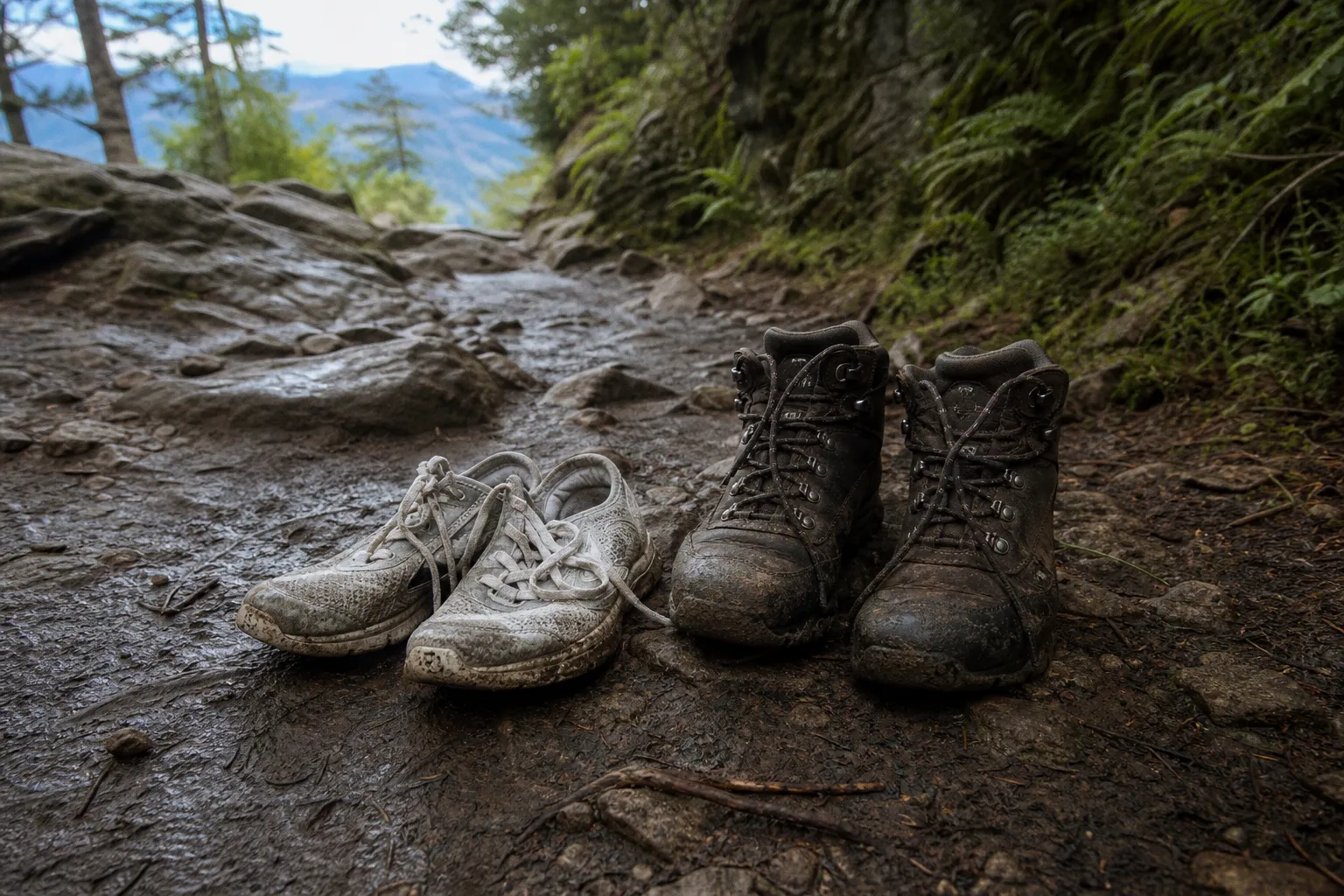
Not because a two-mile loop with 300 feet of gain is secretly K2. It isn’t. The trap is simpler and uglier: the word easy makes people stop thinking. They leave water in the car. They skip navigation. They wear dead sneakers with bald soles. They assume cell service will babysit them. Then a smooth Saturday walk turns into a twisted ankle, a wrong spur trail, a cold wait, and a search-and-rescue report that starts with the same tired sentence: “The hikers underestimated the route.”
Hiking for beginners should start on easier trails. I’m not arguing against that. I’m arguing against treating easy trails like outdoor furniture. They still have weather, terrain, distance, exposure, crowds, heat, mud, roots, loose rock, and your untrained legs dragging the whole mess back to the trailhead.
That’s the work. Respect the simple route before it teaches you the hard way.
Easy trail ratings are blunt tools, not permission slips
Most trail ratings are trying to compress a messy physical experience into one polite word. Easy. Moderate. Hard. That sounds clean. It isn’t.
On many apps, “easy” leans hard on distance and elevation gain. Short route, low climb, soft rating. Fine as a rough filter. Useless as a full risk assessment.
A trail can have low elevation gain and still chew up a beginner because the rating may not fully account for:
- slick roots after rain
- loose gravel on descents
- poor trail markers
- creek crossings that swell after storms
- exposed sections where a stumble has consequences
- heat and no shade
- crowding that forces bad foot placement
- rocky tread that pounds ankles and hips
- confusing junctions near picnic areas or old service roads
That last one gets people. Beginners think navigation trouble happens deep in wilderness. Wrong. It often happens on popular trail systems with too many intersecting paths, social trails, bike connectors, old fire roads, and “shortcut” scars punched into the dirt by people who couldn’t stay on the line.
A clean trail rating does not tell you how your body will move across the ground. It does not tell you how your shoes will grip wet granite. It does not tell you whether your knees know how to brake on a descent without turning your quads into hamburger.
Here’s the difference I care about:
| Trail app label | What beginners often think it means | What it can actually mean |
|---|---|---|
| Easy | No real preparation needed | Low elevation or short distance, but still uneven, hot, exposed, crowded, or poorly marked |
| Family-friendly | Safe by default | Wider access, maybe more people, but not zero risk and not zero navigation |
| Popular | Reliable and simple | Crowded, eroded, more wildlife pressure, more people making bad choices |
| Short | Low effort | Compressed intensity, steep punches, rocky tread, or fast weather exposure |
| Well-traveled | Impossible to get lost | Multiple junctions, social trails, and false confidence |
I use ratings. I don’t worship them.
Before I send a new hiker onto any route, I want the map, the profile, the terrain notes, recent conditions, and the exit plan. Not because I’m dramatic. Because terrain does not care what the app called it.
“Easy” is a label for sorting trails. It is not a contract with your ankles.
Popular beginner trails create beginner problems at scale
The most crowded beginner trails produce a strange kind of risk. You see families, dogs, trail runners, tourists in cotton hoodies, someone carrying one tiny water bottle for three people, and you think: how bad can this be?
Bad enough.
Popular easy trails gather the least prepared hikers because the social proof is loud. If everyone is doing it, it must be harmless. That logic belongs in a shopping mall, not on dirt.
Crowding changes the trail. It widens the tread. It strips vegetation. It pushes people around mud instead of through durable surfaces. It creates braid trails that look official to a tired beginner. It disturbs wildlife. It makes parking lots overflow and trailheads chaotic. It also raises the number of incidents because more people are moving through with less skill and less gear.
Search and rescue teams see plenty of day hikers who thought they were only going for a short walk. Industry safety guidance often points out that a meaningful slice of SAR incidents involves day hikers who underestimated difficulty. The exact percentage varies by place and reporting method, but the pattern is stubborn: short hikes do not protect you from bad decisions.
The beginner trail has its own failure chain:
1. The route looks too simple to study. You glance at the mileage and ignore the map. That is how you miss the confusing loop junction two miles in.
2. The crowd hides the need for self-reliance. You assume someone else will know the way. Then the crowd thins after the viewpoint and you’re suddenly following two people who are also guessing.
3. The pace gets stupid. You try to move with faster hikers and burn your legs early. Cadence gets sloppy. Foot placement gets lazy. That’s where ankles roll.
4. The turnaround decision comes too late. Beginners treat the destination as mandatory. Experienced hikers treat turnaround time as a tool.
5. The descent gets underestimated. Going down feels like the easy half until braking mechanics start loading knees, quads, calves, and hips on every step.
I’ve watched strong gym people get humbled on easy trails because strength in a controlled room is not the same as trail durability. Hiking uses the full kinetic chain under fatigue: foot, ankle, knee, hip, trunk, shoulders if you’re hauling a pack. Uneven ground keeps changing the angle. Your body has to solve the problem every step.
If you have not trained that, the trail will find the weak link.
Cumulative fatigue is the quiet grinder
Beginner hiking mistakes usually look small at first. A little too fast out of the gate. A little too little water. A little too much weight in one shoulder bag. A little too much faith in running shoes that lost their tread last year.
Then the trail starts stacking interest.
Cumulative fatigue is what happens when low-grade stress repeats long enough to become real damage. A flat trail with rocks and roots can beat up a new hiker more than a smooth graded climb. Why? Because every uneven step asks for stabilization. Your ankles torque. Your calves fire. Your glutes try to keep the knees from collapsing inward. Your trunk fights rotation. Nothing feels catastrophic. It just grinds.
After an hour, your foot placement gets worse. After two hours, your posture sags. After three, you stop lifting your feet cleanly. That root you stepped over in mile one becomes the root you kick in mile five.
Beginners obsess over mileage. I care about terrain cost.
Five miles on smooth dirt is not five miles on wet roots. Three miles on loose rock can cost more than six miles on packed trail. One mile of steep descent after your legs are cooked can be the most technical part of the day.
A useful way to read a beginner trail is to ask what kind of fatigue it will create:
- Muscular fatigue: long climbs, stairs, steep pitches, heavy pack load.
- Joint fatigue: hard surfaces, long descents, rock steps, repeated braking.
- Balance fatigue: roots, mud, loose stones, creek crossings, narrow tread.
- Heat fatigue: exposed trail, low wind, reflective rock, humid forest.
- Decision fatigue: poor signage, many junctions, unclear loops, fading light.
That last one is underrated. A tired brain navigates poorly. It also negotiates badly. “Maybe this shortcut goes back.” “Maybe we’re almost there.” “Maybe we don’t need to stop.” That’s not strategy. That’s fatigue wearing your voice.
If you want real hiking tips for novices, start here: don’t measure a hike only by distance. Measure it by what it will demand from your legs, lungs, skin, balance, and brain.
The Ten Essentials are not for dramatic people
The Ten Essentials are the standard for a reason. They are boring. Good. Boring keeps you out of preventable trouble.
For short hikes, beginners often decide the list is overkill. That is exactly when it matters. You don’t need emergency gear because you planned an epic. You need it because small failures do not ask permission to happen close to the car.
The Ten Essentials are:
1. Navigation
2. Headlamp
3. Sun protection
4. First aid
5. Knife
6. Fire
7. Shelter
8. Extra food
9. Extra water
10. Extra clothes
No, that does not mean you need to carry a mountaineering expedition kit on a two-mile loop. It means you carry a scaled version that fits the risk. Lightweight. Useful. Actually in your pack.
Here’s what that looks like for easy trails for beginners:
| Essential | Beginner mistake | Practical version for a short hike |
|---|---|---|
| Navigation | Relying only on cell signal | Downloaded offline map plus a battery buffer or paper map where appropriate |
| Headlamp | “We’ll be back before dark” | Small headlamp, not a phone flashlight that drains your lifeline |
| Sun protection | Thinking shade solves it | Sunglasses, sunscreen, brimmed hat, UPF layer if exposed |
| First aid | Carrying nothing because the trail is short | Blister care, bandage, wrap, pain relief you can safely take, personal meds |
| Knife | Treating it like survival theater | Small blade or multitool for repairs and basic utility |
| Fire | Assuming fire is irrelevant | Weatherproof lighter or fire starter where legal and appropriate |
| Shelter | Laughing at the word shelter | Emergency bivy or compact space blanket |
| Extra food | Bringing only vibes | Dense snack with salt and carbs |
| Extra water | One tiny bottle | Enough for heat, distance, delay, and sharing if needed |
| Extra clothes | Dressing for the parking lot | Light insulation or rain layer when weather can shift |
I keep this stuff tight. I hate bloated packs. But I hate helplessness more.
Load distribution matters too. Don’t throw everything into a floppy tote or carry it in one hand like you’re walking to a barbecue. Use a small daypack with stable shoulder straps. Put dense items close to your back. Keep water accessible. Keep navigation and insulation reachable without unpacking the whole thing in wind or rain.
A short hike does not require fear. It requires margin.
Margin means you can absorb a delay. A wrong turn. A temperature drop. A hot ridge. A blister. A friend bonking because they thought breakfast coffee counted as fuel.
That’s not paranoia. That’s basic field competence.
Hydration is not a personality trait
Beginners routinely underdrink on easy hikes because they think thirst will give them a neat warning. It won’t always. Especially in cool weather, dry air, altitude, or wind.
A common baseline is one to two liters of water for every two hours of hiking. That is not a sacred formula. Body size, heat, humidity, pace, altitude, shade, and sweat rate all torque the number. But it gives you a starting point that is better than “I brought a half-empty bottle from the cupholder.”
Hydration also connects to pacing. If you sprint the first mile because the trail looks gentle, you burn fluid and glycogen early. Then the climb hits. Or the sun clears the ridge. Or the return takes longer because someone’s knee starts barking.
For beginner hiking, I like a simple rhythm:
1. Drink before you start. Not a gallon in the parking lot. Just don’t begin already behind.
2. Sip early. Waiting until you feel cooked is amateur hour.
3. Pair water with salt and food on longer or hotter hikes. Plain water is not magic if you’re sweating hard.
4. Track remaining water at the turnaround point. If half the route is left and you’ve got one sad mouthful, you made a planning error.
5. Carry more in heat than the rating suggests. Trail difficulty labels do not account well for a 90-degree afternoon.
Food is the same deal. You don’t need a feast. You need usable fuel. Bars, nuts, dried fruit, jerky, tortillas, cheese, whatever your stomach handles. Pack out wrappers and scraps. If you’re trying to clean up the whole food loop at home too, even something simple like learning how to start a kitchen countertop compost bin can make your trail habits less sloppy. Waste discipline starts before the trailhead.
And please stop feeding wildlife. A beginner trail with habituated animals is not cute. It is damaged. Your crumbs train animals to harass people and drag human food into the ecosystem. Eat clean. Pack out everything. Stay on trail. Don’t widen muddy sections because your shoes are precious.
The trail does not need your convenience. It needs your restraint.
Navigation: the “obvious” route is where people get lazy
“How to start hiking” advice usually tells beginners to pick a local easy trail. Fine. Then it often skips the part where you learn to navigate because, again, easy.
That’s weak.
Navigation is not only for remote backpacking routes and thru-hiking. It is for every trail system with intersections, loops, side paths, overlooks, access roads, seasonal closures, washed-out signs, or multiple parking areas.
Do this before you start:
- Read the full route, not just the headline distance. Know whether it is an out-and-back, loop, lollipop, connector, or stacked trail system.
- Download the map offline. Cell service often dies exactly where your confidence does.
- Check recent trail reports. Mud, downed trees, closures, icy patches, washed-out bridges, and confusing reroutes matter.
- Know your turnaround point. Destination is optional. Getting back is not.
- Mark the trailhead location. Big lots and multiple access points create stupid endings.
- Tell someone where you’re going. Route, start time, expected return. Simple. Adult. Effective.
- Carry enough battery. Photos, cold weather, weak signal, and navigation drain phones fast.
When you reach a junction, stop moving. Don’t drift through it while half-reading the map. Face the direction of travel. Match the map to the terrain. Look for blazes, signs, drainage, contour, and obvious landmarks. If something feels wrong after a few minutes, stop early. Backtrack while the correction is cheap.
The worst navigation error is not the first wrong turn. It’s the pride that keeps feeding it.
Your body needs trail-specific preparation, not heroic suffering
I don’t care if you can suffer. Lots of beginners can suffer. That doesn’t make them prepared. It just makes the lesson louder.
If you’re new, your goal is not to crush the trail. Your goal is to build durable movement. Ankles that stabilize. Knees that track clean. Hips that carry load. Feet that keep traction. Lungs that recover while moving. A brain that makes decisions before panic gets a vote.
Train the basics:
1. Walk on uneven ground before your first “real” hike. Parks, gravel paths, hills, stairs. Let your feet learn variable surfaces.
2. Build descending strength. Step-downs, controlled lunges, slow downhill walking. Most beginners brake with stiff legs and angry knees.
3. Practice pack carry. A light daypack still changes posture and load distribution.
4. Use poles if they help, but don’t outsource balance to them. Poles can reduce load and improve rhythm. They cannot fix sloppy footwork.
5. Keep cadence short on climbs and descents. Big lunging steps burn quads and wreck control. Short steps keep the chain stacked.
6. Break in footwear before trail day. New boots can shred heels. Old sneakers can slip. Both are preventable.
You do not need expensive gear to start. You need gear that functions. Shoes with grip. Socks that don’t turn into wet sandpaper. Layers that match weather. A pack that carries without bouncing. A map you can use. Water you can reach.
The outdoor industry loves making beginners feel under-equipped and over-inspired. Ignore half of that noise. Buy less. Test more. Walk in bad weather near home. Learn what rubs, leaks, slips, overheats, and fails before you’re three miles from the car.
That is how competence gets built. Repetition under controlled stress. Not a cart full of shiny equipment.
Easy is where you learn the habits that keep you alive later
Easy trails are not the enemy. They are the classroom.
A good beginner hike teaches pace, foot placement, hydration, layering, navigation, and restraint without demanding a rescue if you mess up. That is valuable. But only if you show up like a student instead of a tourist with a phone and a fantasy.
Pick easy trails. Start small. Turn around early if conditions are off. Carry the Ten Essentials in scaled form. Drink before thirst gets loud. Read the map. Respect mud, heat, crowds, and loose ground. Leave the trail better than you found it.
The trap was never the trail rating. The trap was believing the rating could do your thinking for you.