Clay Masterson, Backcountry Conditioning Expert & Gear Pragmatist
July 23, 2026 · 13 min read
Light trail running shoes: why heavier soles are often faster
Light trail running shoes have sold a clean lie for years: less weight means more speed. That logic works until the trail starts taking payment. Add 100 grams to each shoe and aerobic demand rises by roughly 1%. That is real.
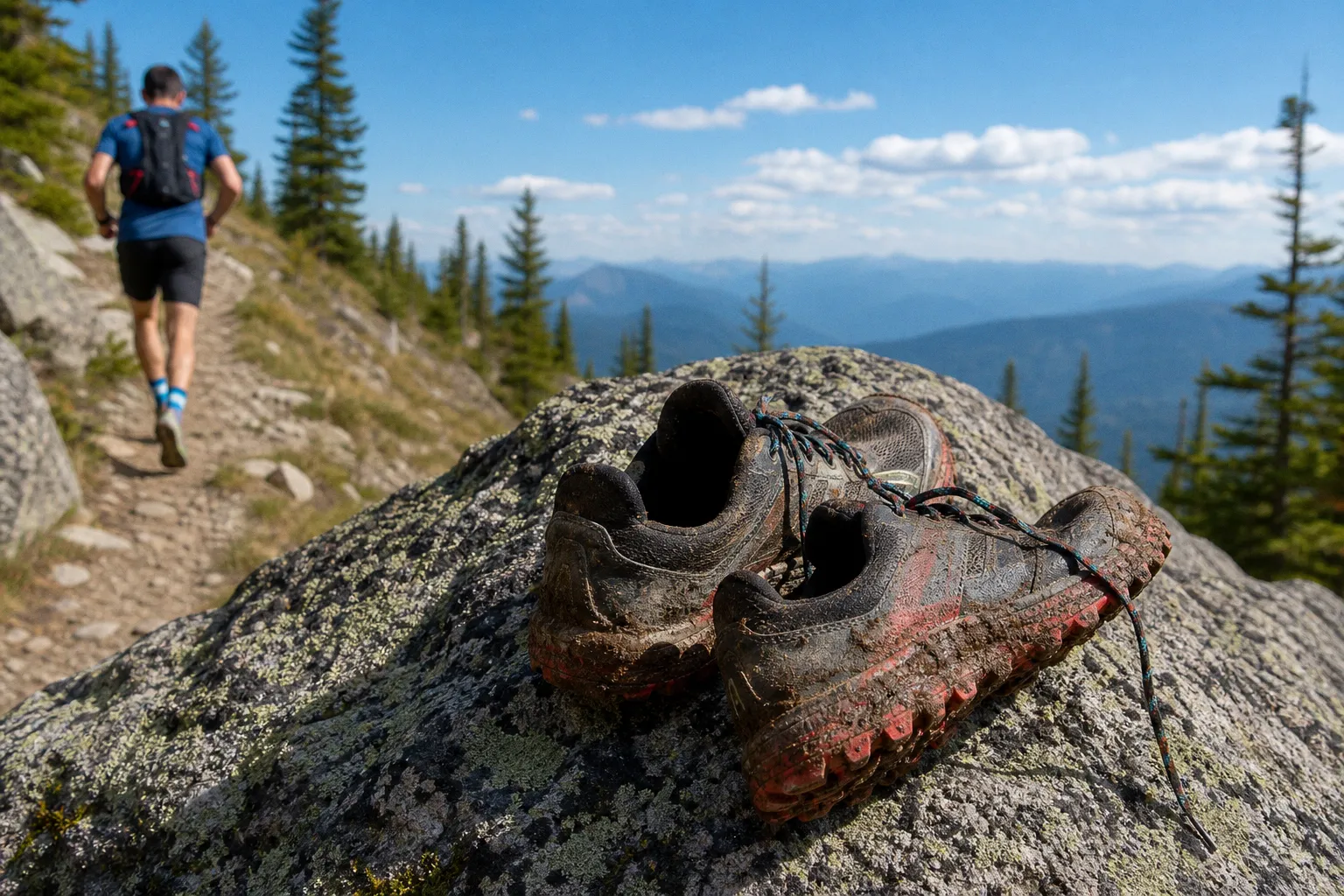
Your leg has to accelerate that mass thousands of times per hour.
But a trail shoe is not a dumbbell strapped to your foot. It is a suspension system, a traction device, and a platform that keeps your kinetic chain from getting shredded when the ground turns ugly. If a slightly heavier sole stops your calves, quads, and stabilizers from doing expensive damage control all day, the scale number stops being the whole story.
I have watched runners obsess over a 20-gram difference in an upper, then lose minutes braking through loose rock because their thin shoe folds, skates, and beats up their feet. That is not “running light.” That is hauling a bad decision through the second half of the race.
The right question is not, “What is the lightest trail shoe?” It is: how much shoe can you carry before the added mass costs more than the protection, rebound, grip, and stability it gives back?
The metabolic cost of mass is real. So is the cost of getting pounded.
Let’s start with the part ultralight fans get right. Shoe mass matters more than weight carried close to your torso. A shoe sits at the far end of a long lever. Every stride swings it forward, brakes it, and swings it again. Add mass there and the hip flexors, hamstrings, and lower-leg muscles pay for it repeatedly.
The useful benchmark is blunt: an additional 100 grams per shoe can increase the aerobic cost of running by about 1%. Over a smooth, firm, predictable course, that penalty is hard to hide. If you are racing a short, dry, nontechnical route at high turnover, a stripped-down shoe can absolutely be the sharp tool.
But that is not most trail running. And it is definitely not most long trail running.
Your body also spends energy absorbing impact. Every landing creates a force problem. Your ankle, calf complex, knee, hip, and trunk have to manage it. A thin, harsh midsole does not eliminate that work. It hands more of the work to your tissues.
That is the core of the cushioning hypothesis: inadequate cushioning forces the body to actively absorb more shock, increasing metabolic cost. Enough well-tuned cushioning can improve running economy by roughly 2.8% to 4%. Suddenly, the 1% weight penalty from a more substantial shoe does not look like a knockout argument.
It looks like one variable.
A trail shoe is not fast because it feels light in the store. It is fast if it lets you keep producing clean strides after the trail has tried to torque you apart.
The mistake is treating every gram as equal. It isn’t. Fifty grams of dead rubber, a soggy upper, or decorative plastic is just ballast. Fifty grams in a resilient foam package, a stable sidewall, and an outsole that prevents slips may reduce the total work your body performs.
That distinction separates useful structure from marketing bulk.
Cushioning is not softness. It is controlled energy management.
“Cushioned” has become a lazy word. Runners hear it and picture a tall, squishy foam mattress. Then they assume the shoe will be slow, vague, unstable, or disconnected from the trail.
Sometimes that is exactly what happens. A sloppy high-stack shoe can turn every off-camber landing into an ankle negotiation. But modern midsole design is not just about piling foam underfoot. The better systems use highly compliant, resilient compounds that compress under load and rebound without collapsing into mush.
That is where Advanced Footwear Technology foams change the math. Compared with traditional trail foams, these materials have shown an average reduction in oxygen consumption of about 1.2% across flat, uphill, and downhill grades. The benefit is not evenly distributed:
| Terrain | Typical efficiency effect from advanced foam | What it means on the trail |
|---|---|---|
| Flat running | About 2.1% lower oxygen consumption | Rebound and impact reduction can preserve turnover over long runnable sections |
| Steep uphill, around +10% | About 1.0% lower oxygen consumption | The mass penalty matters more, but lower leg fatigue can still be reduced |
| Steep downhill, around -10% | About 0.2% lower oxygen consumption | The energy-saving effect is smaller; stability and braking control become the bigger issue |
That downhill number needs context. It does not mean cushioning is useless on descents. It means oxygen consumption alone misses the whole bill. Downhill running punishes eccentric strength: quads lengthen under load, calves stabilize, feet land at awkward angles, and the ankle has to make rapid corrections. You may not burn dramatically less oxygen, but a protective, stable platform can leave you with more usable legs when the descent ends.
That matters in mountain races. It matters on a three-hour training run. It matters if you want to run the final climb instead of doing the stiff-legged shuffle that people call “managing effort.”
A responsive foam also does something basic but critical: it protects cadence. When feet get beat up, stride mechanics degrade. Ground contact gets cautious. You over-brake. Hip extension disappears. Your feet start landing wherever they can rather than where they should. A shoe that maintains comfort without turning vague helps you keep the movement pattern you trained.
The goal is not maximum stack. The goal is enough resilient material to reduce unnecessary muscular absorption while keeping the foot planted and predictable.
The hidden energy penalty is not weight. It is traction failure.
A slip is not a minor inconvenience. It is an energy leak.
When a shoe loses purchase on wet roots, loose-over-hard dirt, slick rock, mud, or decomposed granite, your body reacts instantly. Peroneals fire. Hips correct. The trunk stiffens. The opposite leg adjusts its landing. You burn energy recovering balance, then spend more energy because your stride rhythm is broken.
Do that once in a race and you barely notice. Do it fifty times on a technical route and you have turned your stabilizer muscles into unpaid labor.
This is why the heavy vs. light trail shoes debate often gets framed badly. A lightweight trail runner with a shallow, compromised outsole may save grams while bleeding efficiency every time the surface gets loose. A heavier outsole with aggressive lugs can be faster because it lets you commit to the landing.
Lug depth alone does not tell the full story, but it is a useful indicator of intent. Around 3.1 mm is a practical aggressive depth for mixed and softer trail conditions: enough bite to engage dirt and loose material without feeling like you are running on cleats over hardpack. The rubber compound, lug spacing, edge shape, and placement under the heel and forefoot matter just as much.
Here is what I look for when the course is actually technical:
- Braking lugs under the heel. On steep descents, you need edges that bite when the foot lands slightly ahead of your center of mass. A smooth heel is an invitation to over-brake with your quads instead.
- Open spacing between lugs. Mud needs somewhere to go. Packed mud turns a trail outsole into a road outsole, and then your supposedly grippy shoe becomes a skating lesson.
- Lateral structure around the heel and midfoot. Deep lugs cannot rescue a foot that rolls across the platform every time it lands off-camber.
- A forefoot that bends where your foot bends. Too stiff and you fight the shoe on climbs. Too floppy and the toes work overtime on rock edges.
- Rubber where the trail actually chews. Many lightweight trail runners save mass by thinning the outsole in high-wear zones. Great for the product page. Less great when the shoe loses bite halfway through its useful life.
The same logic applies to soft surfaces. Running on sand can cost roughly 1.6 times as much energy as running on firm ground. Mud, loose scree, snow, and duff are not identical to sand, but they create the same basic problem: the surface deforms and steals force.
A stiffer, more structured sole can reduce how much your foot sinks, twists, and wastes through that deformation. Again, not free. Stiffness can feel punishing on hard ground and can mute foot placement. But on a route with sustained loose terrain, structure can be the difference between driving forward and churning in place.
Maximalist geometry works when it does not wreck your mechanics
Maximalist trail shoes get dismissed by runners who remember early versions: tall, clumsy platforms that felt like running on unstable furniture. Some models still deserve that criticism. High stack without containment is just leverage against your ankle.
But a well-built high-stack trail shoe can reduce long-distance fatigue because it takes some of the repeated shock load out of the system. The benefits are most obvious after the point where lightweight shoes stop feeling “nimble” and start feeling thin.
That point arrives faster than people admit.
On runnable dirt, a moderate-to-high stack lets you land with less guarding. On rocky trail, it spreads point pressure from embedded stones. On long descents, it can reduce the accumulated beating that makes your feet start searching for safe ground instead of moving decisively.
Some research has found around 10 mm of surface cushioning to be an efficient zone for running economy. Do not turn that into a universal prescription. Stack height, foam density, rocker geometry, body mass, and footstrike all interact. Ten millimeters in one construction does not behave like ten millimeters in another.
Still, the principle holds: adequate cushioning reduces the demand on your lower legs. That is not weakness. That is load management.
The trap is using cushioning to cover for poor movement. A tall shoe will not fix an overstride. It will not save you if your hips collapse inward on every landing. It will not make weak calves durable. If your cadence falls apart, the shoe cannot do the work for you.
But if your mechanics are reasonably sound, a properly tuned midsole can preserve them longer. That is a performance advantage.
The shoe should reduce stupid fatigue, not erase the feedback that keeps you moving well.
I want enough trail feel to place my foot. I do not need to feel every pebble with the emotional intensity of a barefoot monk. There is a line between useful sensory information and pointless punishment. Long-distance trail running rewards the runner who can still make good decisions at hour four.
Where light trail running shoes still earn their place
This is not a call to bolt the heaviest shoe in the shop onto your feet. Lightweight trail runners are still excellent tools when the terrain and duration support them.
A low-mass shoe makes sense when you can exploit its advantages instead of spending the entire run compensating for its limits:
1. Short, fast races on dry, firm trails. If the course is compact dirt, moderate grade, and clean footing, less mass can help quick cadence and rapid turnover.
2. Runners with durable lower legs and efficient mechanics. Some athletes tolerate lower stack and flexible platforms exceptionally well. They have conditioned feet, calves, and ankles, not just strong opinions.
3. Courses requiring precise foot placement. Tight rock scrambling, narrow ledges, and highly irregular terrain may reward a lower platform with less ankle leverage—provided the outsole still grips.
4. Training sessions with a specific purpose. A lighter shoe can be useful for hill repeats, short technical sessions, or drills where you want more direct feedback from the ground.
5. Runners who are not carrying much extra load. Add a vest, water, mandatory kit, poles, or a long day’s nutrition, and the demand on the shoe’s platform changes. Your body is not operating under the same conditions anymore.
Minimalist trail shoes are not obsolete. They are specialized. The problem starts when runners turn specialization into doctrine.
Minimalist trail shoes durability is also more than a question of whether the upper survives brush or whether the outsole lasts 400 miles. A minimalist shoe has to remain mechanically useful as it wears. Once a thin outsole loses edge definition or the midsole packs out, the shoe’s small margin for error gets smaller. You feel every missing piece of structure.
That does not make minimal shoes bad. It means you need to stop pretending that a lighter shoe is automatically a tougher choice.
Match the sole to the terrain that will break your form
The best shoe choice usually comes from identifying your failure point. Not your favorite brand. Not the foam color. Not the weight listed in a retailer filter.
Ask what fails first when you run tired on the terrain you actually have.
If your feet get bruised and your stride shortens on rocky trail, you need more underfoot protection. If you keep sliding on wet roots, you need better rubber and lug geometry. If your ankles feel wrung out after off-camber traverses, you need a more stable platform, not necessarily a lower stack. If your calves detonate late in long runs, a more resilient midsole may save more energy than it costs.
Use this rough framework:
| Your common failure point | What the shoe needs | What to avoid |
|---|---|---|
| Bruised forefeet on rock | Protective forefoot foam, rock plate or structured midsole | Paper-thin forefoot built only for scale weight |
| Slipping in mud or loose dirt | Open, aggressive lugs and grippy rubber | Shallow, tightly packed lugs |
| Quad destruction on descents | Stable cushioning, broad landing platform, heel braking | Tall soft foam with no sidewall support |
| Calf and foot fatigue late in runs | Resilient foam with enough stack to reduce repeated shock | Minimal platform chosen out of ideology |
| Fast hardpack racing | Lower mass, responsive geometry, moderate grip | Heavy mud outsole or overly rigid chassis |
| Long mixed-terrain efforts | Balanced cushioning, durable outsole, dependable lockdown | Extremes: stripped racer or oversized cruiser |
Then test the shoe under fatigue. Not by jogging around a parking lot. Not by standing in front of a mirror. Take it onto the kind of descent that usually turns your form into a negotiation. Run the final 30 minutes of a long session in it. See whether your foot stays centered. See whether your toes jam. See whether you can brake and reaccelerate without hesitation.
That is field testing. Everything else is product-page theater.
Stop buying grams. Buy usable speed.
The trail running shoe weight impact is real, but it is not linear and it is not isolated. Mass costs energy. Cushioning can save energy. Traction can save even more by preventing slips and stabilizer-driven corrections. Structure can preserve your mechanics when the terrain gets punishing.
The lightest shoe is often fastest only when conditions are friendly enough that you do not need much shoe. Once the route includes long descents, loose surfaces, fatigue, and technical footing, the equation changes.
I do not care whether your trail shoe is labeled light, maximal, responsive, protective, or race-ready. I care whether it lets you keep moving with force and control when your legs are tired and the ground is trying to steal both.
Pick the sole that reduces wasted work. Then train hard enough to use it.