Clay Masterson, Backcountry Conditioning Expert & Gear Pragmatist
July 11, 2026 · 9 min read
Wood camping stoves are quietly replacing gas canisters
Your fuel canister weighs more than your dinner. That isn't hyperbole — it's a 227 to 450 gram dead weight you haul for three days just to boil water, and most weekend warriors don't even bother…
Your fuel canister weighs more than your dinner. That isn't hyperbole — it's a 227 to 450 gram dead weight you haul for three days just to boil water, and most weekend warriors don't even bother calculating the cost until their knees start complaining about an extra pound bouncing around their hips. The shift away from gas canisters is already underway on long-distance trails, and the reason isn't nostalgia or some back-to-the-land fantasy. It's gasification physics and a weight equation that finally tips in favor of twigs.
Let me be blunt: a wood camping stove is not a romantic choice. It's a mechanical one. You trade the convenience of pushing a button for the discipline of sourcing fuel, managing airflow, and accepting that dinner takes 12 minutes instead of four. For some trips, that's a deal-breaker. For others, it's the only way to keep your pack under 30 pounds over a week of high-mileage hiking.
The Physics of Gasification: How Modern Stoves Burn Cleaner
Open fire is stupid. That's not me being inflammatory — it's thermodynamics. When you light a pile of sticks, most of the energy escapes as smoke and unburned particulates because the fire can't get enough oxygen fast enough to combust the volatile gases released by the heated wood. You see this as a thick column of white smoke and feel it as blackened cookware and the kind of eye sting that makes you reconsider your life choices.
A modern wood camping stove fixes this through gasification. The principle is simple: heat wood in an oxygen-starved chamber, force the released gases through a secondary combustion zone with preheated air, and burn them a second time. The result is a hotter, cleaner fire that uses less fuel and produces a fraction of the smoke.
Gasification isn't magic. It's rocket science applied to the pile of sticks you almost didn't pack out.
The engineering that makes this practical in a backpacking stove is the double-wall design pioneered by companies like Solo Stove and refined across the category. Cold air enters the bottom of the outer wall, travels upward through a gap, heats to several hundred degrees, then gets injected through ports near the top of the firebox. That preheated air ignites the escaping gases that would otherwise become smoke. You see it in real time: the flame pattern shifts from yellow and sooty to a tight blue-orange ring with almost no visible emission.
For the load-bearing athlete, the practical takeaway is this: a well-designed gasifying stove leaves less residue on your pot, burns through less fuel per boil, and produces less of the acrid smoke that triggers your tent-mate's allergies. It also means you spend less time hunched over the stove feeding it, and more time eating or breaking down camp before the next push.
Weight Savings and the End of Fuel Canister Dependency
Here is where the math gets ugly for gas canisters. A standard 227 gram isobutane canister delivers roughly 90 minutes of burn time at moderate output — enough for maybe four to five boils. On a four-day trip with two hot meals and two hot drinks per day, you're carrying two canisters minimum. That is 450 grams of dead weight before you've eaten anything, and it scales linearly with trip length.
Compare this to a portable wood stove for camping weighing between 200 grams (the ultralight titanium models) and just over a kilogram (integrated battery/fan units with thermoelectric generators). You carry the stove once. Fuel is gathered on-trail.
The implications for backcountry athletes are not subtle. Over a week-long traverse, a thru-hiker can save 1.5 to 3 kilograms simply by eliminating fuel canisters. That is the weight differential between trail runners and boots, between carrying a bear can or hanging food, between finishing strong and grinding the last ten miles with fried quads.
There is also the supply chain problem. Gas canisters are not available everywhere. Remote trail towns, international routes, and high-alpine resupply points often stock them inconsistently or at markups that make your wallet hurt. A wood burning camp stove operates on local inputs. Twigs, pinecones, dry leaves, bark strips. The fuel inventory is whatever the forest provides.
The question isn't whether you can carry a canister. It's whether you should, when the alternative burns cleaner and weighs less over four days.
Beyond Boiling Water: Thermoelectric Innovation in the Backcountry
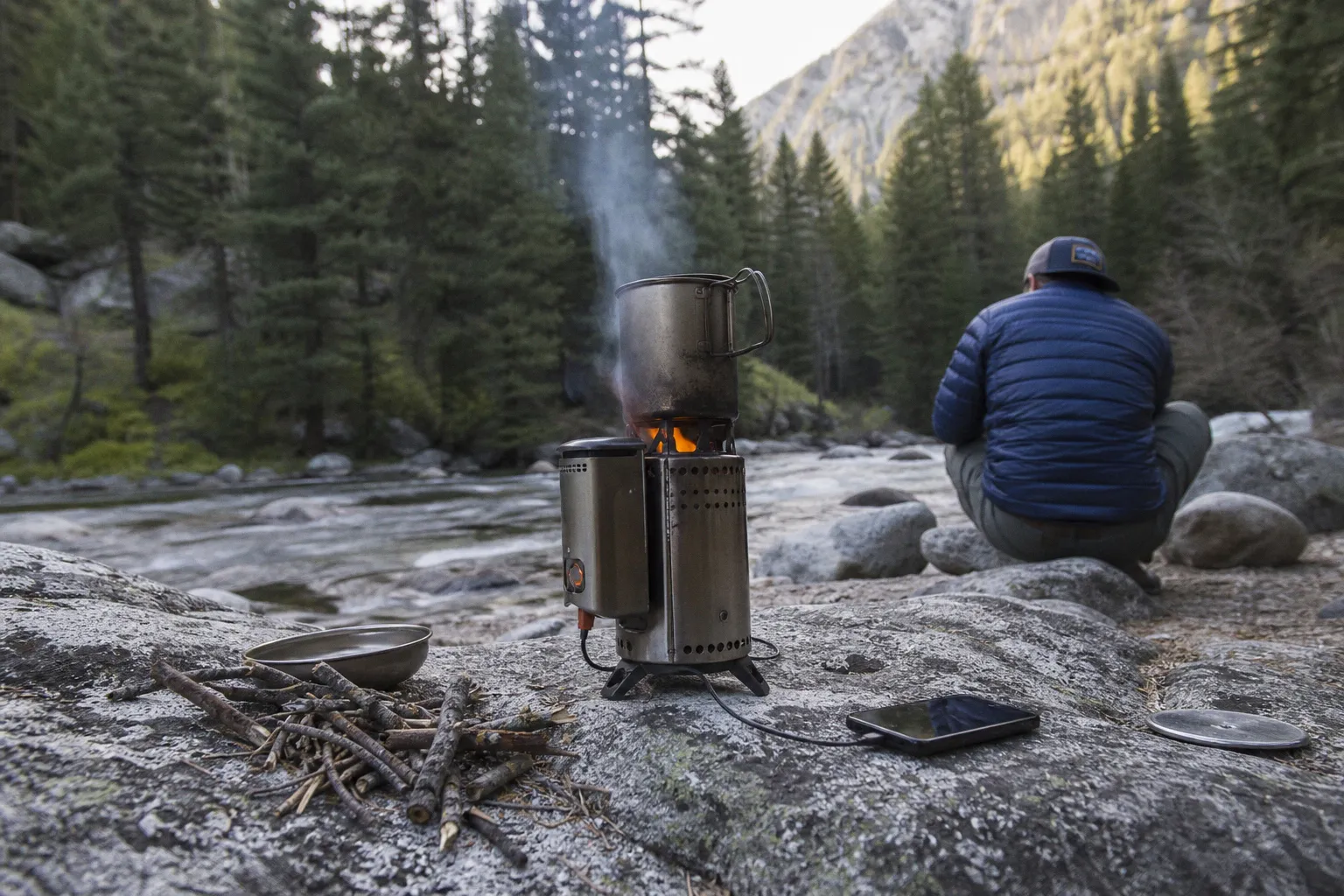
In 2012, BioLite launched the first commercially viable wood stove with an integrated thermoelectric generator. This was not a gimmick. The CampStove 2+ uses a Peltier module positioned against the firebox to convert heat differential into electricity, which is stored in an internal battery and delivered via USB. Plug in your phone, GPS unit, headlamp, or satellite communicator and you have off-grid charging powered by the same fire that boiled your water.
The output is modest — around 3 watts peak — but that is enough to top off a headlamp battery overnight, push a few percentage points into a depleted phone, or keep a GPS unit alive during an emergency. For backcountry athletes running watches, satellite messengers, and phone-based navigation apps, that is not a luxury. It is mission-critical redundancy.
The trade-off is weight and complexity. The CampStove 2+ sits at the heavier end of the category at just over a kilogram, and the thermoelectric system adds moving parts that can fail. But the value proposition is clear: in a multi-day scenario, the ability to generate electricity from the same fire that cooks your food eliminates one more consumable from your resupply list. You are not carrying a power bank. You are not hunting for an outlet in a trail town. You are burning fuel you collected off the ground and pulling watts out of the heat differential.
This is where the wood burning camp stove vs gas conversation stops being theoretical. A gas stove does one thing. A thermoelectric wood stove does that thing plus generates electricity from waste heat. For athletes who treat electronics as survival tools rather than conveniences, the calculus shifts.
Navigating Fire Restrictions and Wilderness Regulations
Here is where most product reviews fail you. They will tell you a wood camping stove is "eco-friendly" and "great for the backcountry" without telling you that half the backcountry may not allow you to light it.
During periods of high fire danger, land management agencies — the US Forest Service, the National Park Service, Bureau of Land Management — implement staged fire restrictions. Stage 1 typically prohibits campfires outside designated rings but may still permit gas stoves. It almost always prohibits wood-burning stoves. Stage 2 escalates further, often banning all open flame including gas stoves in some districts.
Ignorance of fire restrictions is not a defense. It is a federal citation, a trail-closing mistake, and a wildfire starter all in one.
This is the single biggest operational trap of wood stoves. You can do everything right — source dead wood from the ground, keep your fire small, dig a proper lay — and still be in violation because the forest is in Stage 2 restrictions due to a lightning strike 40 miles away. The responsibility falls on you to check current conditions for every management district on your route, every morning, before you light anything.
There is also the high-alpine problem. Above treeline, wood is scarce, slow-growing, and protected. Lichen mats that took 50 years to establish are not acceptable fuel sources, and neither is the dead wood you find at 11,000 feet. If your route crosses significant alpine terrain, a wood stove becomes a non-starter. Period.
The honest assessment: wood stoves are tools, not identities. Treat them with the same regulatory respect you give a chainsaw or a rifle. Know before you go. Check the district. Check the stage. Carry a backup ignition source that complies with restrictions if you are traveling through a high-risk corridor.
The Reality of Manual Fuel Management vs. Gas Convenience
Let's dispense with the marketing. A wood camping stove is not faster than a gas canister stove. It is not more convenient. It is not easier. Anyone who tells you otherwise is selling you something or has not actually used one in cold, wet conditions.
The real workflow looks like this. You arrive at camp exhausted. Before you can eat, you need to source fuel: walking 50 to 100 meters from your site, gathering twigs the diameter of a pencil, breaking dead branches into stove-length pieces, and stacking enough to boil two liters of water and simmer a rehydrated meal. That is 10 to 20 minutes of work in good conditions, longer if the ground is wet or the wind is up.
Then you light the stove. Kindling is harder to ignite than gas. You need finer material, often natural tinder, and patience. The first boil takes 8 to 12 minutes instead of 4. The flame requires occasional adjustment if the wind shifts. You cannot walk away and trust it the way you can trust a gas burner with a windscreen.
This is the cost. Anyone who frames wood stoves as "effortless" or "convenient" is lying to you. They are effortful. They demand attention. They fail in wet conditions more readily than a sealed gas system. They reward preparation and punish laziness.
So why use one? Three reasons.
First, weight over multi-day trips. The math is unforgiving for canisters on a seven-day traverse.
Second, fuel independence. In remote terrain, canisters are not guaranteed.
Third, the satisfaction of running a clean, hot, gasified fire. This is not spiritual fluff. It is the pleasure of operating a well-tuned mechanical system. The flame turns blue, the pot boils fast, the fuel burns to fine ash. There is craft in it.
The best twig stove for backpacking is the one that matches your trip profile, not the one that wins a YouTube comparison. For sub-zero winter camping, gas wins on consistency. For summer desert hiking where fuel is dead wood and wind is constant, the equation flips. For wet coastal forests where everything is damp, you will curse both systems equally.
Choosing Your Burn
The wood camping stove has earned its place in the gear list of serious backcountry athletes. Not because it is a better stove in every metric, but because it solves a problem gas cannot: weight-free fuel on long routes where canisters become logistically and physically expensive.
Treat the shift honestly. It is a tradeoff. You gain weight savings, fuel independence, and in some configurations, off-grid charging. You give up convenience, wet-weather reliability, and the ability to operate under all fire restrictions.
Pick your stove to match your route, your climate, and your willingness to work for dinner. Stop buying gear based on aesthetics or Instagram. Buy it because the physics and the regulations and the terrain align with the tool.
Your knees will thank you for every kilogram you leave behind. The forest will not care which stove you brought.