Clay Masterson, Backcountry Conditioning Expert & Gear Pragmatist
July 19, 2026 · 11 min read
Ultra marathon shoes: lessons from my first 100-mile finish
marathon shoes: lessons from my first 100-mile finish…
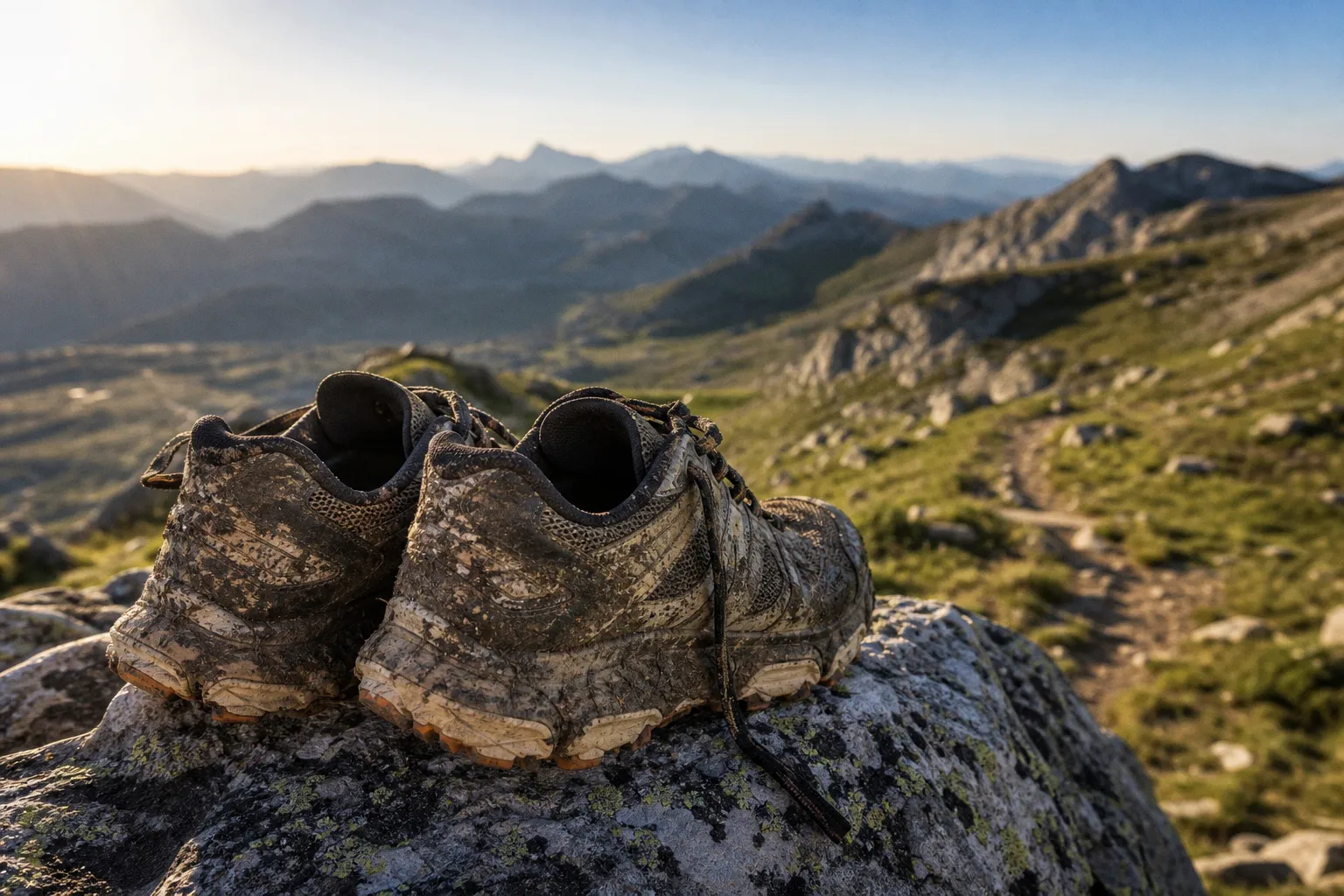
Your feet swell. On a 100-mile day they swell more than you think, more than your training shoes were ever tested for, and more than your buddy's Instagram post about "loving his new shoes for the long haul" ever accounted for. Roughly 160.9 km of repetitive impact, heat, hydration swings, and gravitational punishment rewrites the geometry of your foot in ways a 20-mile training run never will. If your shoes don't account for that, your toenails won't make it to the finish.
I've finished one. Just one. And I'm not going to dress it up as wisdom handed down from some mystical summit. It was ugly, instructive, and expensive in ways I didn't budget for. Here's what 100 miles of ground contact taught me about the only piece of gear you cannot quit halfway through a race.
The Anatomy of a 100-Mile Fit: Why Swelling Dictates Your Size
Stop shopping for the shoe you ran your marathon in. Stop trusting the size that felt perfect on a Tuesday afternoon treadmill session. A 100-miler eats that logic and asks for seconds.
The fit fundamentals come down to three things: length, volume, and forefoot geometry. You want roughly a thumbnail's length of space beyond your longest toe when you're standing, not sitting. You want enough vertical volume that your foot isn't pressing the upper against the metatarsal heads at hour 12. And you want a toe box shape that matches your actual foot, not the one the marketing department decided was "trendy" this season.
Here is the part people ignore: your feet are largest at the end of the day, after gravity has had its way with the fluid in your lower extremities. They are largest after a long training run. They are largest in summer. So try shoes on after your hardest back-to-back training day, in the afternoon, with the socks you actually plan to race in. If the fit feels loose in the store under those conditions, it will be snug at mile 70 when you've been hammering descents for nine hours.
A wide or foot-shaped toe box is not automatically superior. It allows splay, which sounds great in theory. But extra room lets the foot slide laterally inside the shoe, and that slide is friction, and friction at 100 miles is a blister factory. Narrower feet in a wide platform get punished. Wider feet crammed into a narrow last get black toenails and worse. Match the last to the foot, then dial the laces.
Fit is the only feature that survives 100 miles. Everything else is a negotiation.
Navigating the Stack Height and Drop Debate for Long-Distance Stability
Stack height gets treated like a religion. It isn't. It's a dial, and like any dial it has a range where it helps you and a range where it wrecks you.
Moderate-cushion trail shoes sit around 30 mm of stack height or under. Maximum-cushion models push 34 mm to over 40 mm of foam between your foot and the trail. The trade-off is not subtle. More foam means more impact absorption and more protection from sharp rocks. It also means more weight, more bulk underfoot, more material to load on every step, and a higher center of gravity that can compromise stability on technical terrain. You are farther from the ground. That matters when you trip on a root at mile 80 and your ankle has nothing left to react with.
Drop is the difference between heel and forefoot stack height, measured in millimeters. High drop is anything over 8 mm. Moderate is 5 to 8 mm. Low is 4 mm or less. The drop you race in should not fight your natural gait. If you've spent the last two years as a heel striker, jamming yourself into a zero-drop shoe three weeks before race day is a fast track to a strained Achilles or a calf tear that ends your season in the aid station.
I've run everything from a 4 mm drop to an 8 mm drop in training. My 100-miler was done in a moderate-drop, moderate-cushion setup, and that was the right call for the terrain I had. If your race is mostly fire road and gentle singletrack with long climbs, a higher stack can carry you. If it's rocky, technical, and constantly turning, every extra millimeter of platform is a liability.
| Parameter | Moderate setup (≤30 mm, 5–8 mm drop) | Maximalist setup (34–40+ mm, 4–8 mm drop) |
|---|---|---|
| Ground feel | High, reactive | Reduced, muted |
| Rock and root protection | Adequate on most trails | Strong |
| Weight per shoe | Lower | Higher |
| Stability on tech terrain | Better, closer to ground | Compromised when fatigued |
| Achilles tendon loading | Lower for habitual rearfoot strikers | Variable, depends on strike pattern |
| Best course match | Variable, rocky, technical ultras | Long road-to-trail ultras, smoother courses |
Match the shoe to the course. Not the other way around.
Traction and Protection: When to Prioritize Lugs and Rock Plates
Lugs are not decoration. They are your braking system on every descent, your grip on every muddy creek crossing, your edge control on every sidehill traverse. Get them wrong and you will meet the dirt up close.
Deep, widely spaced lugs bite into wet, loose, and muddy terrain. They shed mud instead of packing into slicks. Shallow, tighter lugs feel great on hard-packed, even surfaces but turn into hockey pucks the moment the trail gets soft or slick. If your race has any chance of rain, rooty climbs, or off-camber sections, shallow lugs are a gamble you lose at the worst possible moment.
Rock plates sit between the outsole and the midfoot. Their job is blunt force protection from sharp rocks and roots, and they add torsional rigidity to the shoe so the platform doesn't twist under you when you land wrong on uneven ground. They are a real feature. They are not, however, an ankle brace. A rock plate will not stop you from rolling an ankle, and it will not magically absorb the energy of a bad landing. It just stops a sharp rock from punching through the foam into your metatarsal. That's plenty useful, but understand the limit.
The shoes that survive 100 miles do three things at once underfoot: they grip the surface you're on, they protect you from the surface beneath that, and they don't fold or twist when your form breaks down at hour 18. If your shoe fails any of those three tests, no amount of upper comfort saves you.
Moisture Management: The Trade-off Between Waterproofing and Drainage
There is a seductive pitch in the running industry: waterproof trail shoes. A membrane that keeps water out, keeps your feet dry, keeps you comfortable. The pitch tends to skip what can happen at mile 40 of a wet ultra, when feet are hot, soaked from sweat, and a waterproof liner has fewer escape routes for that moisture than a plain mesh upper.
A waterproof membrane does block external water at the surface. The catch is that the same barrier can work against you once water enters through the collar, the tongue, or the seams of the upper. Waterproof liners can retain water once it gets inside, and because the membrane doesn't breathe outward the way an open mesh does, that moisture tends to sit against the skin, warm up, and soften the tissue over hours of running. That is the setup blisters love.
In persistently wet conditions, where water is going to get in no matter what you lace up, a quick-draining mesh upper may be the better tool. Drainage has an edge over blocking once the water is unavoidable. Feet can stay cooler. The water that enters leaves on the next downhill. Socks and skin spend less time marinating, and friction has less to work with.
Blisters are friction injuries, and friction scales with moisture and heat. An upper that traps warmth and wetness against the foot is generally pushing you toward skin failure at the back half of the race. If your course crosses streams, runs through rain, or sits in humid conditions for long stretches, a breathable, fast-draining upper can do more for your feet than a waterproof membrane in that specific scenario.
For runners who do go waterproof, the trade-off is real. Feet will run warmer, sock choice becomes more important, and keeping external water out at creek crossings, mud pits, and wet grass becomes part of the pacing and line-choice job rather than something the shoe handles for you. Know the cost before you pay it.
Waterproof liners can retain water once it enters through the collar or other openings, while quick-draining mesh may be preferable in persistently wet conditions.
The Danger of Last-Minute Geometry Changes: Protecting Your Achilles
The single dumbest thing I see runners do in the month before an ultra is switch to a low-drop or zero-drop shoe because someone on a forum said it would "activate their natural stride." It will activate something. Probably your Achilles tendon, in the worst way.
A controlled lab study of habitual rearfoot strikers found that minimal shoes and barefoot running increased Achilles tendon loading rates compared with standard shoes. Using a forefoot strike in minimal shoes further increased Achilles tendon impulse. The takeaway is not "minimal shoes are bad." The takeaway is that a sudden geometry change is a transition, and transitions take time, mileage, and progressive load. The Achilles does not adapt on a three-week timeline. It adapts over months, or it tears.
If you've spent your entire running life in an 8 mm drop shoe, jumping to a 4 mm or zero-drop platform eight weeks before a 100-miler is an experiment with your finish line as the control group. If you want to run in a lower drop, do it in the offseason. Build up in shorter races. Add calf-specific strength work. Then bring it to the ultra. Otherwise, race in the geometry you've trained in. Boring advice. Surviving advice.
Same logic applies to any major shoe change: stack height up or down, plate addition, wide platform switch, weight class jump. Every one of those variables changes the load profile on your kinetic chain. Your body adapted to the old profile over hundreds of training miles. The new profile is a stranger until you put in the work to make it familiar.
What the First 100 Actually Taught Me
The shoes matter. They are the only piece of gear you cannot abandon at an aid station. They are also the most personal piece of gear, because they interact with a body that has its own geometry, history, and weak points no spec sheet can predict.
Fit is the foundation. Volume, length, and last shape matched to your actual foot after a hard training day, in your race socks, with your race-day lacing. That is step one.
Cushion and drop are dials, not identities. Set them for the course and your gait, not for what your running club swears by.
Traction and rock protection are non-negotiable on any course that isn't groomed gravel.
Waterproofing is a tool with a cost. It earns its place in cold, wet, short-duration races where the lining still sheds more water than it traps. In long, warm, persistently wet ultras, drainage usually wins. Know the conditions before you choose.
And geometry changes are transitions, not upgrades. Make them months out, not weeks.
Most of the runners I know who DNF'd their first 100 didn't fail because their shoes fell apart. They failed because their feet failed inside shoes that weren't matched to the demands of the distance. The shoes held up fine. The fit, the stack, the drop, the moisture plan, the geometry change they made six weeks before race day — that is where the race ended. And if you're hemorrhaging money on entry fees, gels, travel, and replacement gear like I did building up to that first finish, running the numbers through a proper digital banking setup keeps the financial side of the sport from turning into its own ultramarathon. Discipline on the trail and discipline in the budget — same muscle.
Stop shopping by spec sheet. Stop chasing stack height like it's a personality trait. Stop trusting shoes you haven't put 50 training miles on before committing to a 100-mile race in them. The trail doesn't care what was on sale. Your feet will remember every shortcut you took to the start line.