Clay Masterson, Backcountry Conditioning Expert & Gear Pragmatist
July 26, 2026 · 14 min read
Gas camping stove efficiency: why boil time is a lie
A 90-second boil time tells you almost nothing about how a gas camping stove will perform when you are cold, hungry, running low on fuel, and trying to get dinner done in a crosswind.
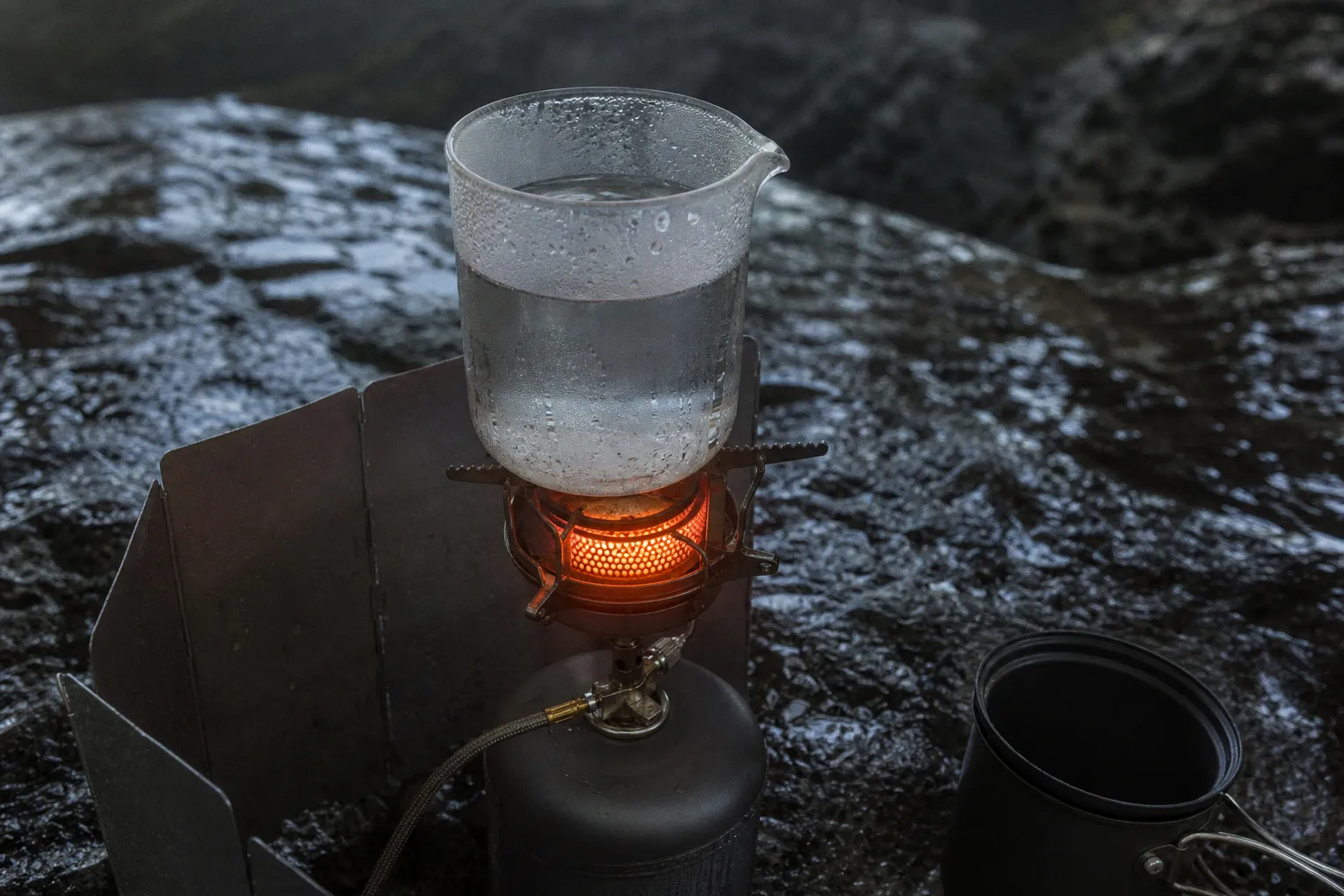
It tells you that, in one manufacturer’s test setup, a certain volume of water reached a visible boil quickly. That is all. It does not tell you how much fuel the stove torched to get there. It does not tell you whether it still works when the canister pressure sags. It does not tell you whether the burner can hold a real simmer instead of cycling between scorched rice and lukewarm sludge.
Outdoor brands know that “boils water in 90 seconds” lands harder than “uses less fuel over four days.” Fast sells. But fast is not automatically efficient, and efficiency is what keeps your meal plan from collapsing halfway through a shoulder-season trip.
I have hauled stoves that looked like monsters on paper and performed like blowtorches with no discipline. Big output. Huge flame. Zero control. They could rage through a half-liter test, then shred a pot of oats because the valve had two settings: off and inferno.
That is not performance. That is marketing with a piezo igniter.
The myth of the universal boil-time benchmark
The first problem is simple: brands do not test the same thing.
A boil-time claim is only useful when you know the water volume, the starting water temperature, the ambient temperature, the elevation, the cookware, the fuel condition, the wind exposure, and what the brand means by “boil.” Most product pages give you a headline number and leave the rest in the fog.
Take three common system-stove claims:
| Stove system | Published boil figure | Water volume | What the number actually reveals |
|---|---|---|---|
| Jetboil Flash Java 1.0L | 120 seconds | 0.5 L | An average across the life of a JetPower canister |
| Primus Lite Stove System | 2 minutes 45 seconds | 0.5 L | Measured with its heat-exchanger pot |
| MSR WindBurner Personal Stove System | 4.5 minutes | 1 L | A larger water volume, paired with fuel-use and burn-time figures |
You cannot stack those numbers in a neat ranking and call it analysis. Jetboil’s 120 seconds is for half a liter. MSR’s 4.5 minutes is for a full liter. Primus explicitly ties its figure to the heat-exchanger pot that comes with the system.
Different load. Different heat capture. Different finish line.
That is the first trap: people treat boil time like a 40-yard dash. It is not. It is closer to comparing two athletes after one runs on a track, another drags a sled, and neither tells you the distance.
A fast stove may be efficient. It may also be throwing heat around the sides of your pot and draining a canister at an ugly rate. A slower stove may be miserly with fuel, especially if its burner, pot geometry, and wind protection keep more heat inside the cooking system.
A stove that reaches a boil fast but empties your canister early is not efficient. It is just loud.
This is where buyers get seduced by wattage and BTUs. A 1.5 kW burner can look modest beside a higher-output burner. But output is only one part of the kinetic chain. The stove has to transfer that energy into the water instead of blasting it into the air.
That means burner pattern, pot diameter, heat exchanger design, lid fit, flame adjustment, and wind exposure all matter. The burner does not cook your meal alone. The whole system does.
Elevation changes the finish line before the stove even lights
Here is the part that gets ignored in almost every “fastest backpacking stove” roundup: water does not boil at the same temperature everywhere.
At sea level, water boils at 100°C / 212°F. At 5,000 feet, it boils at about 94.9°C / 202.9°F. That is not trivia. It changes what a boil-time test means.
At elevation, your stove has less temperature ground to cover before the water starts rolling. So the stopwatch may look better even though your food is dealing with cooler water. If you are rehydrating a freeze-dried meal, making coffee, or melting snow, that difference matters. If you are cooking pasta or trying to soften a dense meal after a long day, it matters even more.
A visible boil is not a universal endpoint. It is a pressure-dependent event.
I see hikers make the same bad call every season: they treat a high-altitude boil as proof the stove is crushing it, then wonder why dinner needs extra soak time. The stove may be doing fine. Physics is simply setting a lower ceiling.
Cold hits the other side of the equation. Canister fuel depends on vapor pressure. As temperatures drop, pressure inside the canister drops. Lower pressure means weaker fuel delivery. Your burner loses its snap. The flame shrinks. The output falls.
A regulated stove can help maintain output as the canister pressure declines, but do not turn that into a fantasy claim. A regulator cannot create pressure that is no longer there. In freezing conditions, pressure can fall below what the regulator can sustain.
That is why a gas camping stove that feels sharp on a warm summer morning can become soft and stubborn at camp in cold weather. The stove did not betray you. You brought a warm-weather assumption into a cold-weather problem.
The field test I actually trust
When I want to know whether a stove deserves space in my pack, I do not run one clean boil and congratulate it. I use it across a trip.
I pay attention to four moments:
1. The first boil on a full, warm canister. This is the easy test. Every decent stove looks competent here.
2. The morning boil after a cold night. This exposes fuel pressure and ignition behavior. Weak canisters and fussy valves show themselves fast.
3. The final third of the canister. A stove that stays responsive late in the fuel cycle earns real points.
4. A dinner that demands control. Oatmeal, couscous, rice, soup, eggs—anything that punishes a burner with a narrow adjustment range.
If you only ever boil half a liter for coffee, you can buy a small upright burner and call it a day. But do not confuse your narrow use case with a universal gear verdict.
Wind, cookware, and fuel pressure: where efficiency gets shredded
Wind is where advertised boil time gets mugged in the parking lot.
A mild breeze can bend the flame, strip heat from the pot walls, and force you to run the burner harder for longer. You hear the roar, see the flame, and feel productive. Meanwhile, fuel is bleeding out of the canister to heat moving air.
A true windproof gas stove is not just a burner that stays lit. Plenty of burners stay lit while wasting fuel. The better question is whether the system protects the flame and captures heat under real exposure.
Integrated systems do this well because the pot and burner were designed together. Heat-exchanger fins increase the contact surface. The burner often nests lower in a protected geometry. A fitted pot and lid reduce losses. These systems can be bulky, awkward for shared cooking, and lousy at delicate simmering—but for fast hot water in ugly conditions, they have a real advantage.
A standard upright canister stove with a plain titanium pot is the opposite end of the spectrum: light, simple, modular, and exposed. It can be excellent. It can also become a fuel grinder when the wind picks up.
Here is how the major variables torque stove fuel efficiency in the field:
- Pot width and burner match: A wide pot over a narrow flame can waste heat around the perimeter. A small pot over an oversized burner can get punished by flame spill and hot spots.
- Heat-exchanger pots: These can move heat into the pot more effectively, especially in integrated systems. But they are part of a matched system, not a magic accessory for every burner.
- Lid discipline: Cooking without a lid is one of the dumbest easy ways to extend boil time. Use the lid unless the recipe demands otherwise.
- Canister temperature: A chilled canister loses pressure. Keep it out of direct snow contact, off frozen rock, and insulated from the ground when conditions are cold.
- Fuel level: A nearly empty canister usually delivers less punch than a fresh one. Do not judge a stove’s output from the last gasps of a canister.
- Flame setting: Maximum flame does not automatically mean maximum useful heat transfer. If flame is licking far beyond the pot base, you may be feeding the air, not the meal.
The last point needs some adult judgment. I am not telling you to always turn the flame down and pretend every stove becomes more efficient at half throttle. That depends on the burner, pot, weather, and cooking task. What I am telling you is to stop treating the full-open valve as the only setting that counts.
A stove is a tool, not a drag racer.
For compact upright burners, use terrain for shelter: a rock, a small rise, the leeward side of a log where legal and safe. The PocketRocket 2 guidance is blunt on this point—wind hurts performance, so shelter the stove behind a natural barrier.
Do not build a foil fortress around a top-mounted canister stove. That is not “dialing in efficiency.” That is how you heat a pressurized fuel canister and turn a simple dinner into a medical evacuation problem.
Fuel per liter matters more than the hero number
If you care about range, the number to hunt for is not merely minutes to boil. It is fuel used per volume of water—ideally measured under stated conditions.
MSR, for example, lists the WindBurner Personal Stove System at 18 liters boiled per 227 g canister, alongside roughly 95 minutes of burn time. That gives you something operational. You can start estimating trip capacity instead of worshipping a stopwatch.
Jetboil lists 10 liters boiled per 100 g canister for the Flash Java system. Again, useful—but only in context. Water temperature, wind, elevation, pot, and test method can shift what you experience in the field.
Still, fuel-per-liter figures are closer to the question hikers actually need answered: how much cooking can I get from the fuel I am carrying?
This is the backpacking stove weight vs power tradeoff in its honest form. A high-output burner can shorten active cooking time. But if it burns fuel aggressively, you may need to carry more canister weight on a multi-day route. A slightly heavier integrated system may earn its keep by using fuel more efficiently in wind. A bare-bones titanium setup may be the right call for a fair-weather overnight, then become the wrong tool for a five-day exposed traverse.
The clean way to think about it is not “Which stove is best?” It is “Where does the total load land after the whole trip?”
That total load includes:
| Trip factor | Fast upright burner | Integrated stove system | Remote-canister stove |
|---|---|---|---|
| Bare stove weight | Usually lowest | Usually higher | Usually highest |
| Wind resistance | Often poor without shelter | Usually strong | Strong when properly shielded |
| Fuel efficiency in calm weather | Can be good | Often very good | Depends heavily on pot and setup |
| Simmer control | Varies wildly by model | Often limited or awkward | Often better for real cooking |
| Cold-weather potential | Limited by upright canister pressure | Limited by canister pressure | Better setup options, but still fuel-dependent |
| Group cooking flexibility | Good with the right pot | Usually limited by included pot size | Strong |
That table is not a shopping list. It is a load-distribution problem.
A solo trail runner doing one hot drink and one freeze-dried dinner has different needs from two hikers melting snow or a group cooking actual food. Stop buying stove power for an imaginary expedition. Stop buying ultralight minimalism for a trip that demands volume and stability.
The same principle applies beyond camp kitchens. In operational efficiency frameworks, the useful question is not whether one step looks fast in isolation; it is whether the whole system wastes less time and fewer resources. Your stove setup works the same way. Burner, pot, fuel, wind protection, menu, and trip duration all pull on the same rope.
Boil time measures a moment. Fuel efficiency measures whether your system survives the trip.
Simmer control is not a luxury feature
Most stove reviews give simmer control a lazy sentence near the end: “The valve allows for good adjustment.” That tells you nothing.
A simmer control camping stove needs to do three things:
- Turn down without dying.
- Hold a stable low flame instead of pulsing and surging.
- Spread heat well enough that your pot does not develop one violent hot spot.
This is where many rapid-boil systems show their limitations. They are optimized to move water toward boiling fast. Fair enough. But a burner built around maximum heat transfer to a narrow integrated pot may not be pleasant for slow cooking.
That does not make it bad gear. It makes it specialized gear.
If your menu is coffee, tea, ramen, and dehydrated meals, a rapid-boil system is hard to beat. You are paying for speed, wind resistance, and convenient heat capture. If you cook rice, sauces, pancakes, fish, or anything that needs patience, you need to test the low end of the valve range before trusting a stove.
I want a burner that can go from rolling heat to controlled heat without making me hover over it like a bomb technician. That matters after a long climb, when your hands are cold and your attention is already compromised.
A bad simmer is more than an annoyance. It wastes food, wastes fuel when you have to restart, and turns camp chores into friction. Outdoor cooking has enough friction already. Do not add more because a brand convinced you that 10,000 BTUs solve every problem.
Windscreens: the shortcut that can get dangerous
Let’s get this clean: do not wrap a windscreen around an upright, top-mounted canister stove.
The burner sits directly above the pressurized canister. A close windscreen can trap radiant and convective heat around that fuel canister. That is dangerous. Not theoretical. Dangerous.
Remote-canister stoves are different because the burner and fuel canister are separated by a hose. That geometry allows more serious wind protection while keeping the canister away from the heat zone. But even there, follow the stove-specific instructions. MSR’s WindPro II, for example, specifies a one-inch / 2.5 cm gap between its windscreen and cookware. That is guidance for that remote-canister design, not a universal measurement to copy onto whatever stove you own.
This is where people get careless because they want to fix a real problem—wind—with an improvised solution. I respect the instinct. I do not respect the execution when it ignores how pressurized fuel works.
Use the right stove architecture for the conditions. Shelter an upright stove with terrain. Keep the canister clear. Keep the flame under the pot. If exposed, windy cooking is a regular part of your trips, spend the weight and money on a system designed for it.
EN 521 covers construction and performance characteristics for portable vapor-pressure LPG appliances intended for outdoor or well-ventilated use. Fine. That does not mean all certified stoves produce comparable boil-time numbers, and it definitely does not mean you can freestyle a windscreen setup.
Certification is a baseline. Field judgment is still your job.
Buy the stove for the work, not the stopwatch
I am not saying boil time is useless. I am saying it is incomplete, and incomplete numbers make people buy the wrong gear.
A quick boil is useful when you need quick hot water. No argument. But a gas camping stove earns trust through repeatable performance: fuel range, wind behavior, valve control, pot stability, cold-canister response, and how much nonsense it demands from you after mile 15.
If you are comparing stoves, strip the marketing down to the useful questions:
1. How much water is the published boil test actually heating?
2. What pot was used—and is it a heat-exchanger system?
3. Is there a fuel-per-liter figure, not just a time claim?
4. What happens when the canister gets cold or runs low?
5. Can the stove hold a low flame for actual food?
6. Does the design fit your wind exposure, group size, and menu?
A 90-second boil looks impressive on a hangtag. A stove that gives you hot food on the fourth wet evening, using the fuel you planned for, is more impressive.
That is the standard. Not speed for its own sake. Work done, fuel preserved, dinner finished.