Clay Masterson, Backcountry Conditioning Expert & Gear Pragmatist
June 24, 2026 · 14 min read
Swap useless bear bells for spray on solo hikes
A bear bell gives you noise. Bear spray gives you a fighting window at 20 to 30 feet.
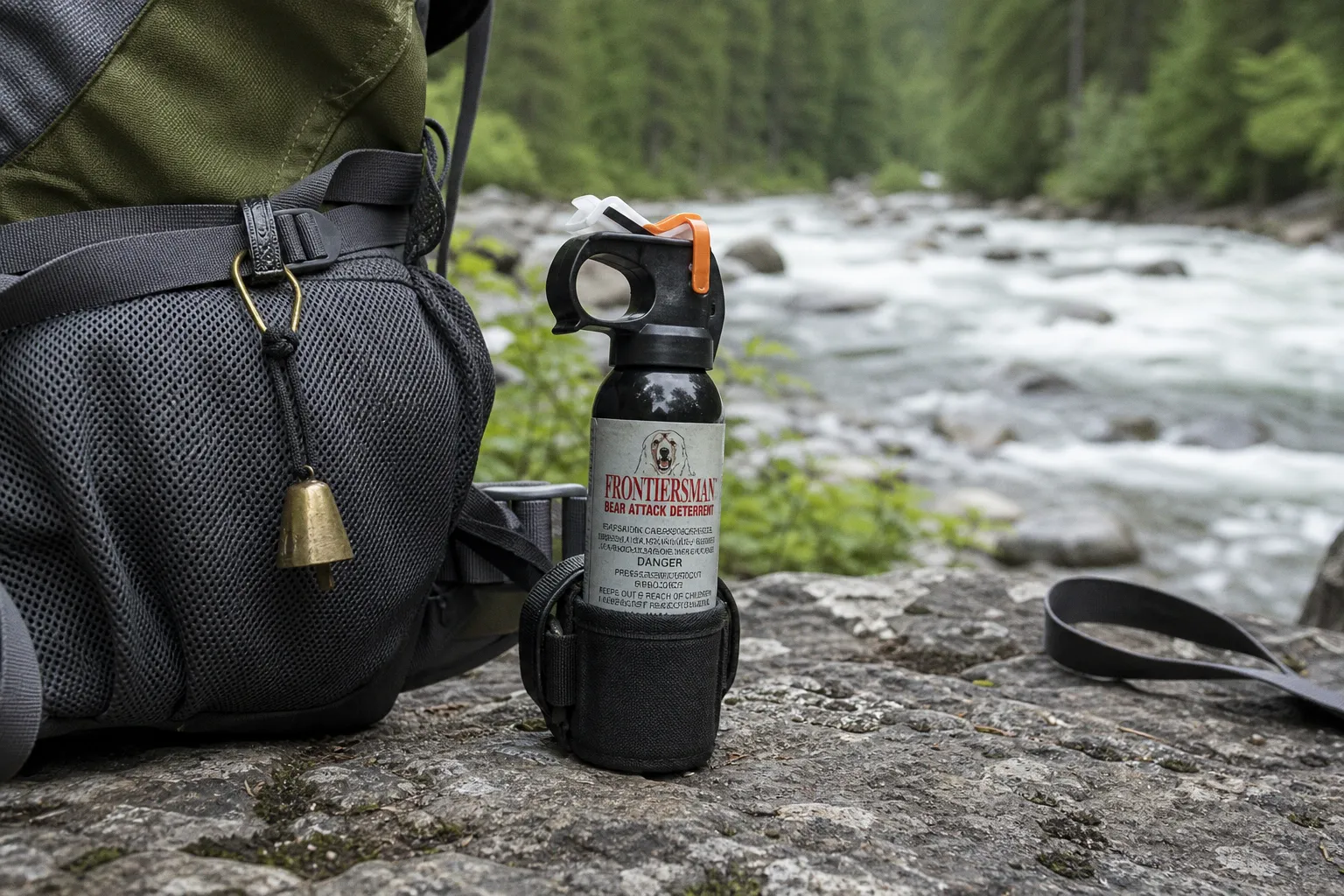
That is the whole problem. Solo hikers keep clipping a tiny jingle to a pack strap and calling it wildlife safety. It is not. It is a comfort object with a split ring. In wind, brush, creek roar, and your own labored breathing, that bell turns into background fuzz. A bear may not hear it. You may not hear anything else because you are letting the bell do the thinking for you.
If you came here trying to figure out how to check swap useless bear bells for spray on solo hikes, start with this: check your system, not your superstition. What is on your body? Can you reach it under load? Do you know the range? Have you practiced the draw? Is the canister EPA-approved and built for bears, not backyard dogs? That is the work.
The woods do not reward lazy systems. They shred them.
The bear bell myth: passive noise is not a safety plan
Bear bells survive because they are cheap, harmless-looking, and easy to sell at the register next to fuel canisters and blister tape. They also let hikers feel like they did something without changing behavior. Clip. Jingle. Done.
That is the trap.
A bell is passive. It makes a thin, repetitive sound. It depends on conditions being perfect: calm air, open terrain, low background noise, and an animal positioned where the sound actually carries. That is not the trail I know. Real backcountry sound gets chewed up. Water hammers through a drainage. Wind torques through lodgepole and alder. Rain taps your hood. Your trekking poles click. Your pack squeaks. Your breathing gets ugly on a climb.
Now add the worst-case terrain: dense brush, blind bends, berry patches, loud streams. Exactly where you need a warning signal most, the bell performs worst.
Human noise works better because it changes. Talking carries cadence and volume. A clap cuts harder. A sharp “hey bear” thrown into brush has more punch than a little metal tick-tick-tick hiding behind your hip belt. You are not trying to entertain wildlife. You are trying to avoid surprising a bear at close range.
I do not care if the bell makes you feel prepared. Feeling prepared is not load distribution. It does not move weight from your knees. It does not keep food sealed. It does not put deterrent in your hand when an encounter compresses from “interesting” to “problem” in two seconds.
A bear bell is not a warning system. It is a tiny permission slip for hikers who do not want to use their voice.
There is also a nasty side effect: hikers wearing bells often stop making deliberate noise. They move quieter than they think. They stop scanning. They outsource attention to a gadget that cannot read terrain.
That is backwards.
Solo travel already narrows your safety margin. No partner watching the flank. No second voice. No one else spotting tracks in mud while you stare at the next switchback. So your margin has to come from discipline. Active noise. Active scanning. Proper food storage. Spray carried where your hand can find it before your brain finishes swearing.
Spray is not magic. It is just the better tool.
Bear spray is not a force field. Do not treat it like one. It will not fix stupid campsite hygiene. It will not make a sow with cubs reconsider your poor route choice every time. It will not help if it is buried under your rain shell, camera, and half a crushed tortilla.
But as a last-line deterrent during a close encounter, it is the standard I want on my body.
Bear spray is a non-lethal deterrent designed to create a cloud of capsaicin-based irritant between you and the animal. Proper bear spray typically contains 1% to 2% capsaicin and related capsaicinoids. It needs EPA approval. It needs enough duration to matter — I want six seconds or more, not a cute little can that empties like a party favor. Most bear spray units have an effective range around 20 to 30 feet, or 6 to 9 meters.
That distance matters. A bear can close ground fast. You are not doing marksmanship. You are building a cloud. Big difference.
A firearm demands accuracy under panic, legal clarity, training, and the willingness to escalate to lethal force. Plenty of people carry one. Fine. But studies and agency guidance have repeatedly pushed bear spray as more effective at preventing injury in bear encounters than firearms. That should get your attention. Not because spray is macho. It is not. It is ugly, practical chemistry. It interrupts the kinetic chain of the encounter without asking you to thread a bullet through chaos.
Here is the blunt comparison I give hikers who ask what to carry.
| Factor | Bear bell | Bear spray |
|---|---|---|
| Primary function | Passive noise | Active close-range deterrent |
| Works in loud water/wind | Poorly | Still usable if deployed correctly, though wind matters |
| Requires skill | Almost none, which is part of the problem | Yes: draw, aim low, spray cloud, move |
| Best use | At most, minor supplemental noise | Last-line defense in a close encounter |
| Accessibility requirement | Usually clipped anywhere | Must be on belt, chest strap, or shoulder strap |
| False confidence risk | High | Moderate if you skip practice |
| Effective range | Not meaningful as deterrent | Usually 20–30 feet / 6–9 meters |
That table is not a gear-review spec sheet. It is a decision tool. One item makes a weak sound. The other gives you a defensive action.
Choose accordingly.
The canister has to be right, and it has to be reachable
A lot of hikers buy bear spray correctly and carry it stupidly.
They tuck it into the side pocket of a pack. They lash it behind a compression strap. They put it in the lid because “it’s right there.” No. It is not right there when your pack is on, your shoulders are tight, and your hands are shaking.
Bear spray belongs where you can draw it with one hand while moving.
Good locations:
1. Belt holster on the hip belt. Fast draw. Natural hand path. Works well if the holster does not get trapped under a jacket hem.
2. Chest strap mount. Strong option for solo hikers because it stays visible and central. Less interference from pack pockets.
3. Shoulder strap holster. Good if it rides stable and does not bounce into your jaw on descents.
4. Front accessory pouch only if the draw is clean. If you need to unzip, dig, or look down for more than a second, it fails.
Bad locations:
- Inside the main pack.
- Buried in a lid pocket.
- In a tent.
- In the car at the trailhead.
- In your partner’s pack when you are hiking solo. Yes, I have heard that one. No, physics did not approve.
You also need to check the canister itself. Not obsessively. Competently.
Look for EPA approval. Look for bear-specific labeling. Look for the concentration range: 1% to 2% capsaicin and related capsaicinoids. Look for a useful spray duration — six seconds or more is the practical benchmark. Check the expiration date printed by the manufacturer. Do not invent shelf life. Do not assume the can is fine because it looks clean.
Then practice the draw with an inert trainer if you can. If not, rehearse with the safety on, pointed in a safe direction, away from people, pets, and tents. Build the pattern until it is boring.
Draw. Thumb safety. Aim slightly downward in front of the charging animal. Spray a cloud. Adjust for wind. Move away when you can.
Wind matters. Around 30 feet per second and above, deployment gets ugly. Gusts can blow spray off target or back toward you. That does not mean spray is worthless in wind. It means you need to understand angles and not stand there like a tent stake. Shift. Create the cloud where the animal must move through it. Protect your airway if blowback hits. Keep your feet under you.
This is where outdoor safety starts to look like any other serious system. Audio guys understand signal, interference, and output better than most hikers, which is why even a rabbit hole like car audio and electronics can teach the same boring truth: weak signal in a noisy environment gets buried. Your bell is weak signal. Your voice and spray are stronger tools.
Do not make the trail solve your bad setup.
Active noise: use your lungs, not a trinket
Making noise does not mean screaming every ten steps until you hate yourself. It means placing sound where surprise risk is high.
Solo hikers need rhythm. Not panic. Rhythm.
I use active noise in zones:
1. Blind corners. Before the turn, not after. Throw your voice ahead.
2. Dense brush. Especially shoulder-high vegetation where sightlines collapse.
3. Noisy water. Creeks, falls, snowmelt channels, wind-torn ridgelines. Sound masking is real.
4. Food terrain. Berry patches, salmon streams, carcass country, oak mast, anything that stacks calories for wildlife.
5. Low visibility. Fog, dusk, heavy rain, tight timber.
Your voice carries more useful information than a bell. It varies in pitch and volume. It identifies you as human more clearly. It can be directed. A clap punches through brush. Trekking poles struck together can help, but do not get cute with it. The point is not making music. The point is reducing surprise.
Here is a simple noise protocol that does not turn you into a trail nuisance:
- On open trail with good sightlines, talk occasionally or call before blind terrain.
- In brush or near loud water, call out every 20 to 30 seconds.
- If visibility drops, shorten the interval.
- If you see fresh sign — scat, tracks, torn logs, digging, overturned rocks — increase noise and slow down.
- If you smell carrion, hear huffing, see cubs, or find a carcass, back out. No debate. No content capture. Leave.
Do not whisper because other hikers might judge you. I would rather annoy a stranger for three seconds than surprise a bear at ten yards.
And stop wearing earbuds in bear country. I know. Your playlist improves your cadence. Your podcast makes road miles less boring. Save it for the gym or one ear at low volume in lower-risk terrain where it is legal and sane. In actual bear habitat, your ears are part of the system. Use them.
The solo hiker protocol: five checks before you leave the trailhead
If you want the practical version of how to check swap useless bear bells for spray on solo outdoor trips, run this before your boots hit dirt. Not in the garage three weeks ago. At the trailhead.
1. Can I reach my spray under load?
Put the pack on. Buckle the hip belt. Clip the sternum strap. Add rain shell if you expect weather. Now draw.
If the canister snags, relocate it. If your jacket blocks it, fix that. If your shoulder mobility is tight from hauling a heavy pack, use a chest mount or belt position that suits your actual body.
Your kinetic chain changes under load. A draw that feels smooth in the kitchen can turn clumsy when your pack is grinding into your traps and your hip belt is locked down.
2. Is the canister current and bear-rated?
EPA-approved. Bear-specific. 1% to 2% capsaicin and related capsaicinoids. Enough spray duration. Not expired. Not damaged. Not a tiny personal-defense spray made for city use.
This is not the place for bargain-bin improvisation.
3. Do I know today’s wind?
You do not need a meteorology degree. You need awareness. Which way is the wind moving at the trailhead? Is the route exposed? Are gusts forecast? Are you climbing into alpine terrain where wind will torque hard across open slopes?
Wind can limit spray effectiveness. It can also change fast. Keep reading it all day.
4. Do I have a food plan that does not invite trouble?
Bear spray is not a substitute for clean camping. If you are overnighting, your food storage has to be squared away. Use the required method for the area: bear canister, approved locker, proper hang where appropriate and legal, or other local standard. Cook away from your sleeping area. Store scented items with food. That includes toothpaste, wrappers, sunscreen, and the greasy spoon you think does not smell.
Bears do not care about your categories. They care about odor and calories.
5. Am I ready to turn around?
This is the check hikers hate. Good. It matters.
If the trail is choked with fresh sign, if visibility collapses, if you find a carcass, if you keep bumping into conditions that stack risk, turn around. Fitness does not outrank judgment. Your summit plan is not a blood contract.
Competence is not carrying more gear. Competence is knowing when the gear is only your last chance, not your plan.
What to do when the encounter happens
You cannot script every bear encounter. Species, behavior, distance, cubs, food, terrain, wind — it all matters. But you can avoid the two classic solo-hiker failures: freezing too long and fumbling too late.
First, stay human. Speak calmly. Do not run. Do not scream. Do not throw food. Identify yourself with your voice and posture. Back away if the bear is not approaching aggressively. Give space. Do not crowd it for a photo. Do not try to “read the moment” like you are hosting a wildlife documentary.
Second, get the spray in hand early. Early is not the same as spraying early. If a bear is visible and distance is closing or uncertain, the canister comes out. Safety tab ready. Arm position stable. Feet balanced. You can always not spray. You cannot draw from inside your pack during a charge.
Third, if the bear charges into effective range, deploy the cloud. Most canisters are built around that 20- to 30-foot zone. Aim low enough that the cloud rises into the animal’s face path. Use a burst. Adjust if needed. If wind is crossing, compensate. If blowback hits you, keep moving and do not collapse into panic.
Fourth, leave the area. Do not stand around celebrating your tactical masterpiece. You just had a wildlife conflict. Create distance. Report the encounter if local management asks for it or if the animal remains near a trail or campground.
And if you discharged spray, treat the canister like a partially used emergency tool. Replace it if remaining volume is questionable. Do not hike deeper into bear country with a half-solved problem clipped to your belt.
The gear industry wants accessories. The backcountry wants behavior.
There is a whole market built around giving hikers little items that feel like readiness. Bells. Charms. Tiny whistles. Novelty “survival” kits that would lose a fight with wet cardboard. Some of it is harmless. Some of it becomes harmful when it replaces skill.
A bell does not teach you to read fresh scat. It does not teach you to slow down before blind brush. It does not make you store food properly. It does not help you deploy under stress. It does not give you range, duration, or a deterrent cloud.
Spray does not make you invincible either. But it demands a better relationship with risk. You have to choose the right canister. Mount it correctly. Practice. Think about wind. Understand distance. Pair it with noise and food discipline.
That is the trade I want.
If you still want a bell as a backup noisemaker, fine. Clip it on your dog’s collar at camp if local rules allow dogs and you are managing that situation correctly. Hang it from a pack if it makes you happy. But do not count it as your bear plan. Do not tell new hikers it is enough. Do not let the jingle flatten your awareness.
Solo hiking is a clean test of your systems. There is no committee. No second set of eyes. No partner carrying the tool you forgot. Every weakness gets hauled by you.
So strip the setup down.
Carry EPA-approved bear spray with 1% to 2% capsaicin and related capsaicinoids. Choose a canister with practical range and at least six seconds of spray duration. Mount it where your hand can reach it under load. Make active noise in the terrain that deserves it. Store food like you respect the animals and the next hiker. Turn around when the signs tell you the margin is gone.
The bell can stay in the drawer.
The trail does not need your jingle. It needs your attention.